The Ultimate Guide to Topsail Island Sheepshead Fishing
Commonly known as the "Convict Fish" for their distinct black-and-white vertical stripes and their uncanny ability to steal bait without triggering a typical rod-tip bend, sheepshead are a highly prized target for inshore anglers in the coastal North Carolina region. As May arrives and our ambient coastal waters warm up significantly, these toothy bottom feeders migrate inward from offshore wintering reefs toward our local pilings, rock jetties, and bridges in massive numbers. For watermen looking to test their reflexes and secure some of the cleanest, flakiest fillets available in the sound, topsail island sheepshead fishing becomes the ultimate late-spring pursuit.
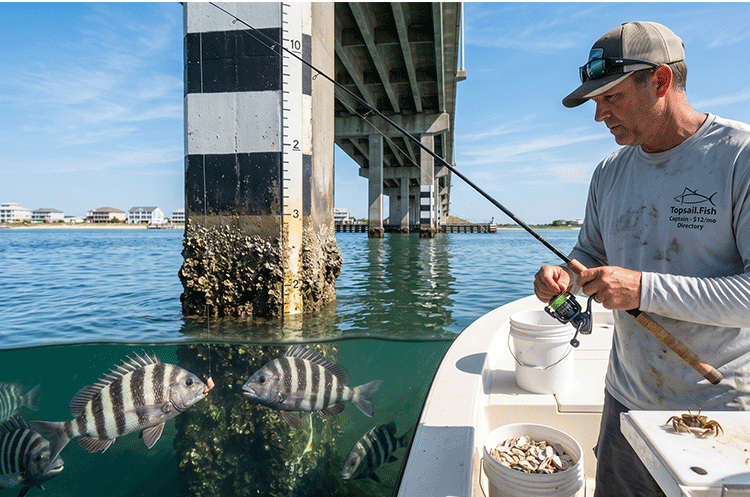
Whether you are positioning a skiff directly against the concrete fenders of the Surf City Bridge, scanning private docks along the winding Intracoastal Waterway (ICW), or casting into the boulder configurations guarding our inlets, mastering the sheepshead bite requires a specialized approach. These fish do not strike like aggressive red drum or trout; instead, they use their human-like incisors to crush hard-shelled prey directly off the structures, leaving unprepared anglers swinging at empty water. Success requires matching your terminal tackle to their unique biology and learning to sense the subtlest line pressure changes.
Why May is Prime Time for Sheepshead
In the greater Topsail area, the month of May marks the absolute sweet spot where inshore water temperatures consistently hit the mid-60s to low-70s range. This temperature spike triggers a massive, localized feeding frenzy. After spending the colder months spawning on deeper nearshore wrecks, mature sheepshead move back into our shallow estuaries to aggressively scrape nutrients from barnacle-encrusted structures. Unlike the winter months when they remain entirely out of reach for light-tackle anglers, May brings them right into our backyards, concentrating them in predictable holding zones where they stay throughout the summer.
Top Spots: Where to Find Them in Topsail
Sheepshead are entirely structure-dependent creatures. You will virtually never catch them roaming over open, featureless sand flats or muddy channels. They live where their food grows. When plotting your navigation route this May, target these three high-yield geographical zones:
- The Surf City High Rise Bridge: The massive, deep concrete pilings supporting this structural landmark act as an endless vertical buffet. Focus your efforts on the columns flanking the main navigation channel where the tidal current flows strongest. Sheepshead position themselves on the down-current side of these pilings to escape the main push of water while scraping away fresh growth.
- New River Inlet Jetties and Rocks: The submerged boulder configurations and hard rock structures lining the northern tip of North Topsail Beach provide world-class forage shelter. Barnacles, small mud crabs, and grass shrimp pack the crevices here, making this an incredible incoming-tide destination.
- Older Residential Docks: Any mature wooden or concrete dock structure featuring heavy, long-term barnacle growth between Surf City and the southern tip of Topsail Beach is a potential goldmine. Look for docks that sit adjacent to deeper sound channels ($6 \text 12 \text$ of water at low tide).
Pro Tip: The "Scrape" Method
If the bite feels slow or the fish are tracking timidly, use a long-handled, flat-edged metal scraper to systematically knock fresh barnacle shells off a bridge support piling directly into the water. This action creates a completely natural, high-potency chum slick that sinks vertically down the piling, drawing sheepshead out from deep within surrounding structures directly to your staging zone. Drop your baited hook cleanly down the face of the scraped piling immediately after executing this trick.
The Best Bait: Getting Past the Clever Thieves
To consistently catch sheepshead, you must present the exact hard-shelled forage they are programmed to crush. Artificial lures are virtually useless here; live or incredibly fresh natural bait is mandatory. In southeastern North Carolina, three distinct bait choices reign supreme:
- Live Fiddler Crabs: The absolute best bait for tracking sheepshead around Topsail Island. Collect them along local muddy marsh banks at low tide or purchase them from local bait houses. Thread the hook cleanly through the rear side of the shell just above the back leg, keeping the hook point exposed to ensure a solid connection upon strike.
- Fresh Sand Fleas: Also known as mole crabs, sand fleas are an exceptional choice, particularly when fishing the rock walls at New River Inlet or the beachfront breakers. Look for large, soft-shelled "orange egg" females for the best results.
- Live Grass Shrimp: A premier backup choice that sheepshead cannot resist. However, because shrimp possess soft bodies, you will frequently have to battle through aggressive schools of bait-stealers like pinfish and juvenile croakers before a target sheepshead can find your hook.
Essential Rigging for High-Abrasion Structure Fishing
Precision terminal rigging is everything when fishing heavy structure. You want your bait resting inches from the piling face, but your main fishing line must stay clear of the razor-sharp barnacle edges that can slice through standard monofilament instantly. We strongly advise dropping traditional heavy rigs in favor of a specialized, down-scaled **Inshore Carolina Rig** built for maximum sensitivity:
- The Hook Matrix: Utilize a small, short-shank #1 or 1/0 2X-Strong Octopus or Circle Hook. You want the hook completely hidden beneath the shell of a fiddler crab, but tough enough not to bend when compressed by the fish's powerful jaw plating.
- The Leader Line: Run a short $12\text18\text$ leader composed strictly of $25\text$ or $30\text$ premium fluorocarbon. The exceptional clarity of our sound water in May makes fluorocarbon's low-visibility profile an absolute necessity, while its rigid construction provides maximum abrasion resistance against concrete and barnacle edges.
- Weight Configuration: Use a minimal $1/2\text$ to $1\text$ egg sinker, sliding freely on your braided main line above a quality barrel swivel. Scale your weight down as small as possible; you want just enough lead to track vertically down the piling face without sailing away in the current.
When your rig hits the bottom, pull your line tight to minimize slack. Sheepshead do not swim away with a bait; they inhale it, crush the shell with their teeth, strip the meat, and spit out the hook in a fraction of a second. If you feel a distinct, heavy "thump" or notice a strange, slight upward slacking of your line tension, lift your rod tip with a swift, firm upward sweep immediately. As the local saying goes: *"You have to strike just before they bite!"*
Inbound Internal Linking Strategy
Because tidal speed determines exactly how fast bait washes through these structural columns, timing your sheepshead trips with active water movement is absolutely critical. Review our cornerstone analysis, What Tide is Best for Fishing Around Topsail, to perfectly coordinate your structure fishing with peak velocity cycles.
Experience the Structure Hunt with a Professional
Successfully maneuvering a vessel inches away from massive concrete bridge buffers, holding position in turbulent inlet currents, and sensing the subtle bite of a sheepshead carries a steep physical learning curve. If you want to skip the trial-and-error phase and step directly into a premium bite with the freshest live bait available, booking an experienced local charter captain is your smartest path forward. Explore our verified, comprehensive Topsail Island Charter Captains Directory to partner with a USCG-licensed guide and book your next late-spring inshore trip today!
Are you a Topsail Area Captain?
Grow your charter business with an SEO-optimized listing in our directory. For just $12/month, we help you reach more anglers and secure the consistent bookings you need to thrive.

Master the Bite: Plan Your Next Catch
Now that you’ve learned about this species, take the next step by checking what’s biting this week, learning when this fish is at its seasonal peak, reviewing recent captain reports, improving your techniques, and finding a local captain to put you on the fish.
🎣 Planning a fishing trip to coastal North Carolina? Before choosing a charter destination, discover why many anglers prefer Topsail Island’s less crowded waters, productive back bays, and outstanding inshore and surf fishing opportunities.
🎣 Planning a trip to the NC coast? Before you book a boat down south, check out why Topsail vs. Wilmington fishing offers a better backwater experience. 🎣
Own a Fishing Charter Around Topsail Island?
Get your business in front of local anglers searching for fishing charters, guides, and inshore adventures on Topsail.Fish. Our directory listings are designed to help captains improve online visibility, increase bookings, and build a stronger local presence.
Professional listings start at just $12/month.