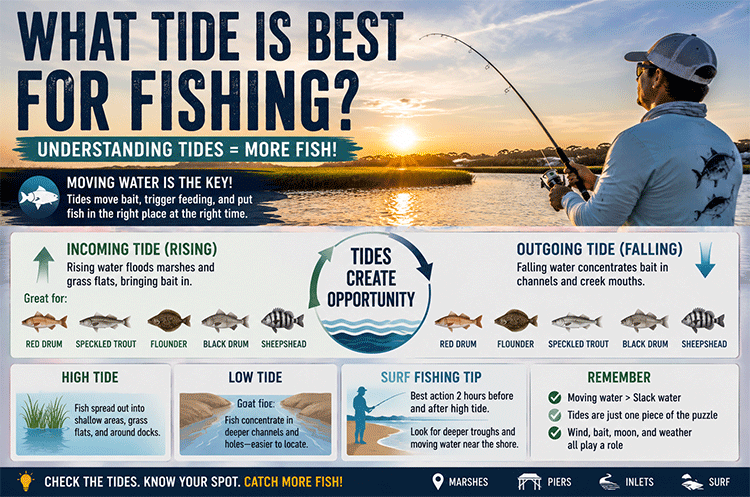
What Tide Is Best for Fishing? Understanding Tides Around Topsail Island
One of the most common questions anglers ask across coastal retail shops and boat ramps is: what tide is best for fishing? The answer depends heavily on the specific species you are targeting, the distinct geographic location you are fishing, and the type of underwater structure nearby. However, around Topsail Island and the surrounding southeastern North Carolina coast, moving water is universally the primary key to unlocking consistent fishing success. Understanding these movements transforms random casting into highly calculated, productive hunting windows.
Tides control marine bait migration, local water depth variations, physical current velocities, and predatory feeding patterns. As a result, mastering how tides work can dramatically improve your chances of catching tournament-quality red drum, speckled trout, summer flounder, black drum, sheepshead, and many other coastal gamefish. In our tidally driven marine ecosystem, static water equals stagnant fishing, while moving currents function as a mandatory dinner bell.
Why Moving Water Matters: The Biological Displacer
In almost all saltwater and estuarine environments, marine fish feed significantly more aggressively when water is actively moving. Incoming and outgoing tides act as massive hydraulic pumps, physically pushing baitfish, finger mullet, brown shrimp, blue crabs, and other vital prey items through narrow marsh drains, deep Intracoastal channels, turbulent inlets, and directly along our beachfront breakers.
When the current moves, predatory gamefish instinctively position themselves near physical structures and natural ambush choke points. For example, red drum commonly hold tightly against the down-current edges of oyster beds, dock pilings, creek mouths, and grass edges, waiting for the moving water to sweep disoriented bait directly into their strike zones. This behavior allows them to conserve crucial caloric energy while maximizing predatory efficiency.
Meanwhile, completely slack water—which occurs during dead high tide or dead low tide when the current ceases to flow for roughly thirty to forty-five minutes—often causes localized feeding activity to drop to a complete standstill. Without current to displace bait, gamefish scatter or rest along deep basins until the water pressure builds and shifts directional movement once again.
Incoming Tide Fishing: The Inshore Flood Window
Many experienced local guides and seasoned tournament anglers firmly believe the incoming (flood) tide is the absolute best tide for general inshore fishing around Topsail Island. During a rising tide, cool, clean, highly oxygenated ocean water pushes directly out of the Atlantic and floods into our shallow sounds, winding coastal creeks, and expansive backwater mudflats.
This incoming column surges over shallow grass lines and expansive oyster rocks that were exposed to dry air just hours prior. This depth shift allows micro-forage like grass shrimp and mud minnows to move deep into safety. Consequently, large predator fish follow closely behind this water line, using the newly available depth to hunt previously inaccessible flats. Kayak anglers exploring hidden pathways like Utleys Channel, the dynamic marshes behind Surf City, or the backcountry networks behind North Topsail Beach often experience outstanding action during the exact middle stages of a rising tide when the current velocity hits its peak run.
Primary Target Species for the Flood Tide:
- Red Drum: Roam shallow flats and tail along flooded cordgrass stalks searching for fiddler crabs.
- Speckled Trout: Position along main creek channels and high-flow dock faces to intercept shrimp flushes.
- Sheepshead & Black Drum: Push vertically up against barnacle-encrusted bridge supports and vertical rock structures as the water line climbs.
Outgoing Tide Fishing: The Funnel Mechanism
Conversely, outgoing (ebb) tides can create equally spectacular fishing opportunities, leaning heavily on the mechanics of containment. As water drains rapidly out of the shallow interior creeks and expansive cordgrass marshes, baitfish and shrimp are stripped of their shallow hiding places and forced to retreat out of the grass into main channels and structural pinch points.
Because the geography collapses around the forage, predator fish stack up heavily directly in front of creek mouths, muddy drains, and deep sound-side holes, waiting for the receding current to deliver an endless conveyor belt of food. Therefore, outgoing tides are extremely effective for targeting dedicated ambush predators like summer flounder, which lay completely camouflaged in the sand at the foot of these drains, waiting to snap at anything washing overhead.
High Tide vs. Low Tide: Structural Shifts
Understanding high vs. low water requires modifying your physical casting coordinates. High tide allows fish to spread out across massive feeding shelves, which often requires anglers to cover substantial amounts of water using search-style artificial lures. Low tide, however, strips away the water covering the flats, completely forcing gamefish off the shelves and into highly predictable, compressed channel cuts and deep pockets. This structural compression often makes locating fish significantly easier because entire school frameworks become concentrated into small sections of water.
| Tidal Stage | Hydraulic Character | Angler Strategy | Target Inshore Structure |
|---|---|---|---|
| Early Rising (Flood) | Slow acceleration, clean water moving in | Stalk outer bars and channel entry points | Oyster bar tips, deep marsh edges |
| Mid Rising to High | Maximum velocity, flooding flats | Cast shallow, fish parallel to grass walls | Flooded Spartina grass, shallow docks |
| Early Falling (Ebb) | Water pulling off flats rapidly | Position vessel down-current from drains | Marsh creek mouths, interior drop-offs |
| Dead Low Water | Slack current, minimal depth inside sounds | Slow down presentations, target deep holes | ICW channel edges, deep scour basins |
Best Tide for Surf Fishing: Reading the Beach Breakers
For surf fishing along the miles of sandy beaches spanning Topsail Island, many expert beach casters heavily prefer the two hours before and the two hours after a peak high tide. Rising water pushes migrating bait schools closer to the shore and creates deeper, safer water columns inside the primary beach troughs running parallel right where the shorebreak crashes onto the wet sand.
Species like southern pompano, sea mullet (whiting), black drum, and red drum frequently feed aggressively during these high-water phases because their sensory systems track the sand fleas and coquina clams freshly exposed by the churning surf water. Additionally, changing tides around critical ocean access points like New River Inlet and New Topsail Inlet create highly localized, violent cross-currents that draw massive, migratory bull drum and mature bluefish into prime casting distance for heavy surf rods.
Watch the Conditions Carefully: The Multi-Variable Moving Target
Although tracking tides is an essential component of coastal angling success, it is important to remember that hydrographics represent only one piece of a complex marine puzzle. Barometric pressure changes, wind direction, localized water clarity, lunar moon phases, live bait presence, and sudden summer weather developments all interact with tidal movements to dictate overall fish behavior.
For example, a sustained, powerful northeast wind can physically hold water inside our local sounds, slowing down an outgoing tide or dirtying the beachfront surf zone so severely that fish cannot see your presentation, regardless of a perfect high-tide graph. Meanwhile, calm, crystal-clear water conditions paired with a moderate incoming tide can produce world-class light-tackle fishing. The most successful anglers learn to synthesize daily tidal timing with real-time weather forecasts and seasonal fish habits.
Before you pack your tackle boxes, trail your boat, or load your kayak, make sure to bookmark our live Topsail Island local marine forecast and tide chart. This dedicated monitoring page provides real-time tide graphs from NOAA for both New Topsail Inlet and New River Inlet, along with live Windy.com radar feeds tracking wind speed metrics, atmospheric temperature shifts, and precipitation patterns across our entire coastal zone.
Final Thoughts on the Best Tide for Fishing
So, what tide is best for fishing? In almost all coastal environments, the best fishing occurs when the water column is actively moving and building velocity. Around Topsail Island, both incoming and outgoing tidal stages can produce spectacular, memory-making action depending entirely on the specific species you seek and the structural zone you choose to fish. By committing to study how local fish react to changing currents, you can completely eliminate the guesswork and dramatically elevate your catching ratios across the gorgeous sounds, inlets, and beaches of North Carolina!
Fishing locally around Topsail Island? Read our detailed Topsail Island Tide Guide for local wind stacking rules and two-inlet tactics.
Own a Fishing Charter Around Topsail Island?
Get your business in front of local anglers searching for fishing charters, guides, and inshore adventures on Topsail.Fish. Our directory listings are designed to help captains improve online visibility, increase bookings, and build a stronger local presence.
Professional listings start at just $12/month.

Keep Building Your Topsail Fishing Skills
Want to put this technique to work on your next trip? Use these Topsail.Fish resources to check current fishing activity, match your tactics to the season, review local conditions, and find more step-by-step fishing guides.
🎣 Planning a fishing trip to coastal North Carolina? Before choosing a charter destination, discover why many anglers prefer Topsail Island’s less crowded waters, productive back bays, and outstanding inshore and surf fishing opportunities.
🎣 Planning a trip to the NC coast? Before you book a boat down south, check out why Topsail vs. Wilmington fishing offers a better backwater experience. 🎣

Are you a Topsail Area Captain?
Grow your charter business with an SEO-optimized listing in our directory. For just $12/month, we help you reach more anglers and secure the consistent bookings you need to thrive.