The Essential Foundation of North Carolina Bottom Fishing
Whether you are standing in the breaking suds of North Topsail Beach or dropping down over live-bottom ledges miles off the coast, structural terminal rigging efficiency dictates your daily catch rate. Among the deep arsenal of angling knots, learning how to tie a dropper loop for surf fishing stands as an absolute non-negotiable skill for any angler looking to build high-yield multi-hook presentations. This specialized loop knot allows you to create a clean, standalone attachment point pointing directly outward from your main leader line at a perfect 90-degree angle.
This structural framework keeps your live sand fleas, fresh cut shrimp, or delicate bloodworms suspended cleanly in the water column rather than tangled around your running line.
The beauty of the dropper loop lies in its hydrodynamics and structural integrity. In high-energy water zones like New River Inlet, standard blood knots or simple overhand loops quickly buckle under the constant churning of waves and longshore currents. A properly thrown dropper loop distributes the inline tension evenly across the core axis of the leader material. This structural security ensures that when a heavy Florida pompano or a citation-sized sea mullet slams your bottom bait, the knot tightens down on itself rather than clipping or cutting under sudden friction.
Furthermore, by mastering this single knot configuration, you completely eliminate the financial burden of purchasing pre-made, high-visibility nylon retail rigs, allowing you to tie stealthy, customized fluorocarbon bottom rigs on the fly right from your tackle bucket.
Step-by-Step Technical Guide: Tying the Perfect Dropper Loop
To successfully tie this knot in heavy monofilament or stiff fluorocarbon leader material, consistency in your wraps is paramount. Follow this precise structural blueprint to ensure your loops stand straight out and resist slipping under heavy pressure.
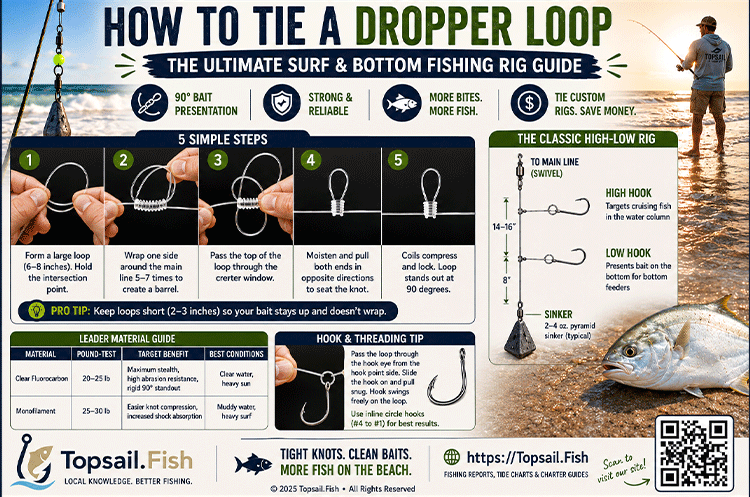
- Form the Primary Inversion Loop: Pull out a section of your chosen leader material (20-to-30-pound test is ideal for local beaches). At the exact location where you want your first hook suspended, form a large, overlapping circle roughly 6 to 8 inches in diameter. Secure the intersection point firmly between your thumb and forefinger.
- Execute the Concentric Inner Wraps: Reach inside the circle and begin wrapping one side of the loop line around the main standing line. You must complete a minimum of 5 to 7 full concentric rotations. This creates a tightly wound spiral barrel section with a distinct open gap or window right in the dead center of your wraps.
- Isolate and Pass the Loop Apex: Use your fingers to keep that central window open. Take the outer top edge (the apex) of your original large loop, pull it downward, and feed it cleanly through the center of that open window space.
- Seat the Barrel Knots Interactively: Moisten the entire line structure with water or saliva before pulling it tight. This step is critical; dry friction will instantly scorch monofilament or fluorocarbon lines, dropping the overall breaking strength by up to 50 percent. Hold the projecting loop in your teeth or over a rigging tool, then pull the two main standing tag ends in opposite directions simultaneously.
- Final Compression Check: As you pull the standing lines outward, the outer coils will compress smoothly inward toward the center, locking the base of the loop firmly in place. Give the loop a firm pull to ensure the wraps are stacked perfectly flush against each other with zero overlapping cross-riding lines.
⚓ Free Printable Companion Resource: Want to keep these exact knot-tying illustrations handy at your rigging bench or on the beach? We have compiled the full 5-step infographic layout into a high-resolution, printer-friendly format[cite: 1, 2]. Download our Printable Dropper Loop Rigging Guide PDF to slip straight into your tackle box for your next trip[cite: 1].
Pro Rigging Tip: Keep your loops short! A dropper loop that is too long (greater than 4 inches) will drape loosely down the leader line, causing your bait to wrap around the main spine during a long-distance power cast. A tight 2-to-3-inch loop keeps your hooks standing out perfectly perpendicular like a miniature outrigger arm.
Optimizing Line Selection: Fluorocarbon vs. Monofilament
When engineering custom high-low rigs, your choice of leader material directly impacts how easily the knot sets and how stealthily it performs in changing water clarities. For our local surf zones, clear fluorocarbon lines remain the gold standard. Fluorocarbon possesses a refractive index nearly identical to saltwater, making your structural dropper connections virtually invisible to sharp-sighted target species navigating shallow bars.
Additionally, fluorocarbon line is significantly stiffer than standard monofilament nylon. This inherent material memory is highly advantageous when learning how to tie a dropper loop for surf fishing because the natural rigidity of the line forces the loop to spring directly outward away from the main leader line, drastically reducing line twist in heavy shorebreak currents. However, because fluorocarbon is inherently slicker and harder than monofilament, it requires precise lubricating and heavy, uniform pressure during the final seating phase to guarantee the inner coils compress and lock down with absolute structural symmetry.
| Leader Material Type | Recommended Pound-Test | Target Structural Benefit | Optimal Local Surf Condition |
|---|---|---|---|
| Clear Fluorocarbon | 20 lb — 25 lb | Maximum stealth, high abrasion resistance, rigid 90-degree standout | Clear water columns, heavy midday sun exposure |
| Premium Monofilament | 25 lb — 30 lb | Easier knot compression, increased shock absorption on heavy hooksets | Turbulent, muddy water or heavy winter storm swells |
Building the Classic North Carolina High-Low Surf Rig
Now that you can throw a flawless individual loop, you can build the ultimate multi-hook bottom presentation utilized by top local surf anglers across the state. The classic double dropper rig—popularly known as the High-Low Rig—allows you to target two completely different levels of the water column simultaneously while introducing double the scent and visual appeal into your target fishing slough.
To construct a tournament-ready high-low presentation, cut a clean 40-inch section of 25-pound fluorocarbon leader. On the bottom end, tie a simple surgeon’s loop or attach a heavy-duty rolling swivel to hold your pyramid sinker (typically 2 to 4 ounces depending on current velocity). Move roughly 8 inches up from the sinker connection and tie your first dropper loop; this is your “Low” hook position, designed to present baits directly along the sand to bottom-feeders like whiting and black drum.
Move up another 14 to 16 inches from that first knot and execute your second dropper loop. This forms your “High” hook position, suspending your bait up into the moving water column to flag down cruising schools of bluefish or high-swimming pompano. Finish the top of the rig with a small, size 6 rolling swivel to connect directly to your main running line. To understand how to position this finished rig correctly inside shifting beach troughs and sandbar cuts, make sure to read our comprehensive spatial guide, What Tide is Best for Fishing Around Topsail.
Hook Selection and Threading Mechanics
A common mistake when utilizing the dropper loop framework is trying to knot a hook directly to the loop itself. Doing so completely defeats the purpose of the presentation. Instead, you want to utilize a clean “loop-to-loop” threading technique that allows you to change out damaged hooks in seconds without cutting your entire rig apart.
To attach your hook correctly, compress the tip of your dropper loop tightly between your fingers until it forms a flat, narrow point. Pass this compressed loop directly through the front eyelet of your hook from the hook-point side. Slide the hook completely down the line until the loop opens up wide enough to pass over the entire bend and point of the hook. Pull the line back up snug against the eyelet. The hook is now perfectly trapped and swinging freely on the loop loop-arm. For targeted surf species like pompano and sea mullet, highly specialized inline circle hooks (such as the Owner Mutu Light or Gamakatsu Circle Hooks available at leading industry outlets like Gamakatsu) in sizes #4 up to #1 ensure clean, automatic corner-of-the-mouth hooksets without the need for violent rod jerks.
Sustainable Fishing and Rig Management
As responsible stewards of our coastal marine fisheries, managing your terminal gear properly ensures our local waters remain healthy for generations to come. When surf fishing around high-abrasion structures like the Surf City Pier pilings or shallow rock outcroppings, continuously inspect your dropper loop barrels for micro-frays or visual scaling. A compromised knot will eventually fail, leaving synthetic line and metal hooks behind in the marine habitat. If a knot shows signs of structural wear, cut it out immediately, discard the scrap line safely in a dedicated recycling receptacle, and tie a fresh loop right on the spot.
For further deep-dives into procuring top-tier organic baits to match with your newly tied custom rigs, check out our master tactical blueprint, Bait School: Choosing And Using The Best Live Baits For Topsail Success.
Elevate Your Beach Game with Local Professional Coaching
Mastering precision knot craft, interpreting volatile offshore weather patterns, and identifying high-percentage beach sloughs carry a definitive learning curve for visiting anglers. Partnering with an authorized, licensed regional charter guide skips the trial-and-error phases entirely, providing your family with direct access to fine-tuned terminal tackle setups, specialized long-distance beach equipment, and real-time local expertise. Browse our verified Topsail Island Charter Captains Directory to pair up with a premier beachfront fishing specialist and lock in your custom coastal booking today!
Keep Building Your Topsail Fishing Skills
Want to put this technique to work on your next trip? Use these Topsail.Fish resources to check current fishing activity, match your tactics to the season, review local conditions, and find more step-by-step fishing guides.
🎣 Planning a fishing trip to coastal North Carolina? Before choosing a charter destination, discover why many anglers prefer Topsail Island’s less crowded waters, productive back bays, and outstanding inshore and surf fishing opportunities.
🎣 Planning a trip to the NC coast? Before you book a boat down south, check out why Topsail vs. Wilmington fishing offers a better backwater experience. 🎣
Own a Fishing Charter Around Topsail Island?
Get your business in front of local anglers searching for fishing charters, guides, and inshore adventures on Topsail.Fish. Our directory listings are designed to help captains improve online visibility, increase bookings, and build a stronger local presence.
Professional listings start at just $12/month.