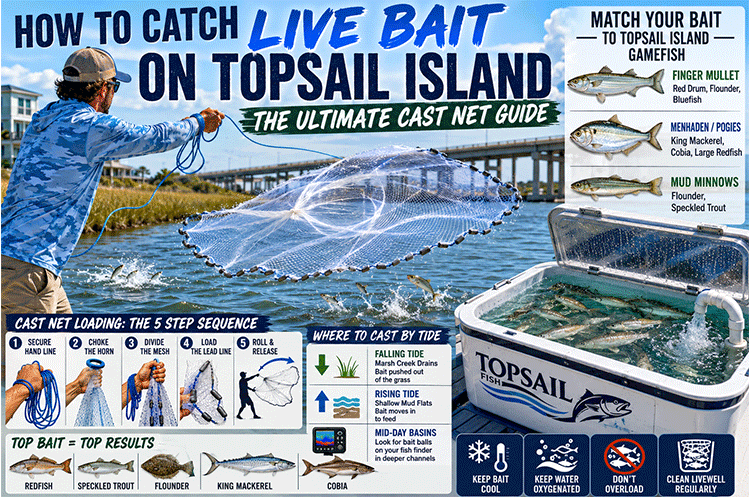
Matching Your Bait to the Topsail Island Marine Ecosystem
Nothing beats a live, kicking baitfish when you are targeting predatory gamefish around Topsail Island. Whether you are hunting structural red drum along the Surf City High Rise Bridge or casting for gator trout near New River Inlet, matching the localized forage is the single fastest way to guarantee a tight line. While buying frozen shrimp blocks or stale bait at the local tackle shop can save time, it cannot match the sheer drawing power of a fresh, locally caught finger mullet, menhaden, or grass shrimp. Learning how to catch live bait on topsail island utilizing a cast net is a vital, money-saving skill that transforms greenhorn tourists into high-producing local anglers.
Southeastern North Carolina’s estuarine systems are dynamic environments driven by intense tidal flows, shifting sandbars, and shallow mud flats. Successfully throwing a cast net here is not just about physical throwing mechanics; it requires an intimate understanding of where bait fish seek shelter across various tide cycles, selecting the proper mesh sizes, and learning to read subtle surface ripples. Attempting to throw a massive, heavy net blindly into deep water will simply exhaust you and muddy up your boat deck. Instead, taking a calculated, tactical approach to bait collection yields superior results with a fraction of the physical effort.
Selecting the Perfect Net for Topsail Backwaters
Before you take your first throw on the water, you must select a net that matches our unique coastal topography. For general inshore bait collection along the Intracoastal Waterway (ICW) and our shallow sound flats, a 6-foot radius net (which opens into a 12-foot circle) is the absolute sweet spot for most adult anglers. If you are casting from a kayak or teaching young children, downsizing to a 4-foot or 5-foot net provides far better physical control.
The physical composition of the net matters tremendously for operational success:
- Mesh Size: For summer and autumn finger mullet, select a 3/8-inch square mesh. This size is small enough to trap juvenile forage without gilling them, yet large enough to sink rapidly through the water column. If you are targeting larger menhaden (pogy) in deeper sound basins, step up to a 1/2-inch or 5/8-inch mesh.
- Lead Weight: Look for a net that carries at least 1 to 1.25 pounds of weight per radius foot. In our high-velocity tidal creeks, a net that is too light will float downstream horizontally rather than sinking straight to the floor, allowing swift schools of mullet to swim underneath the lead line before it closes.
Local Hydrographic Connection: Because bait movement is entirely driven by current acceleration patterns over our shallow flats, mapping your throwing sessions around active water cycles is critical. To master how tidal flow changes these bait concentration windows across our sounds, review our cornerstone structural analysis, What Tide is Best for Fishing Around Topsail.
The Manual Loading Sequence: Throwing Clean Circles Without Your Teeth
The most common failure point for visiting anglers is trying to load a cast net using their teeth or getting completely soaked in marsh mud. This simple, highly efficient loading method relies entirely on hand mechanics, keeping your upper torso clean and dry while maximizing centrifugal force for a full circular opening.
- Secure the Hand Line: Place the hand loop securely around your non-dominant wrist. Coil the remaining hand line in large, neat loops into your non-dominant hand, ensuring there are no twists or kinks in the rope.
- Choke the Horn: Grasp the top plastic ring of the net (the horn) with your non-dominant hand, holding it directly below your looped hand line coils. Raise your hand up to let the monofilament mesh drop straight down naturally, shaking out any tangled lead weights.
- Divide the Mesh Weight: Reach down with your dominant hand and grab the body of the net approximately midway down its length. Loop this upper half of the mesh back up into your non-dominant hand. You should now be holding the coiled rope, the horn, and the center mesh fold all cleanly in one hand.
- Load the Lead Line: Look down at the hanging bottom weights. Grab a section of the lead line that sits closest to your body. Bring it upward and drape it over your non-dominant thumb or forearm. This creates an open pocket inside the net structure.
- The Final Roll and Release: Reach down and grab an un-loaded section of the lead line with your dominant hand. Roll your upper body back slightly, using your hips to swing the net in a smooth, continuous horizontal arc. Release the net as your hands pass your target, allowing centrifugal force to open the circle cleanly across the surface film.
⚓ Free Printable Companion Resource: Want to keep these exact cast net loading and throwing illustrations right at your rigging bench or on your boat? We have compiled this full 5-step instructional infographic layout into a high-resolution, printer-friendly format. Download our Printable Cast Net Throwing & Bait Guide PDF to slip directly into your tackle bucket.
Mapping Local Bait Hotspots: Where to Cast by Tide
Once you master the physical throw, you must locate the targets. Bait fish movements around Topsail Island are entirely driven by the stage of the tide. You can throw a perfect circle all day long, but if you are casting into empty space, your bait tank will stay dry.
The Falling Tide: Marsh Creek Drains
As the ocean water drops and empties out of our shallow sound marshes, baitfish like finger mullet and juvenile mud minnows are physically forced out of the safety of the tall cordgrass beds. Position your skiff or wade quietly downstream from small feeder creek mouths where they empty into the main ICW. Cast your net directly into the deeper channel drop-off seams just below the draining flat.
The Rising Tide: Shallow Mud Flats and Boat Ramps
As fresh ocean water pushes back inland, bait schools will eagerly cruise up onto shallow mud flats to feed on organic matter. Look for small, distinct “V-wake” ripples cutting across calm water surfaces, or listen for the faint popping sounds of schooling mullet jumping along the banks. Wading quietly along the sound-side beaches near Soundside Park or the high-rise bridges during an incoming flood tide offers exceptional, visual casting options.
Deep Mid-Day Basin Tracking
When the bright mid-day sun heats up the shallows, larger bait fish like Atlantic Menhaden will pull off the banks and school up tightly in the center of deep dredged canals, yacht basins, and the deeper holes surrounding our inlets. To track down these schools, monitor your fish finder for dense, cloud-like columns hovering midway up the water column, and ensure your net features a heavy lead line to drop rapidly through the deeper water before the school scatters.
| Target Bait Type | Optimal Inshore Location | Best Tide Segment | Preferred Target Gamefish |
|---|---|---|---|
| Finger Mullet (3-5 inches) | Shallow mud flats & marsh creek banks | Early incoming / Late falling | Red Drum, Flounder, Bluefish |
| Menhaden / Pogies | Deep ICW channels & marina basins | Peak high flood tide | King Mackerel, Cobia, Large Redfish |
| Mud Minnows | Oyster bar edges & salt marshes | Low dead slack water | Flounder, Speckled Trout |
Tactical Release and Bait Tank Preservation
Because our summer water temperatures frequently climb into the 80s, keeping caught bait alive inside an automated livewell requires precise oxygen management. Never overload your tank; a dense swarm of stressed mullet will rapidly exhaust the dissolved oxygen levels, causing the entire school to die before you arrive at your fishing destination. Drop a handful of fresh bait fish into your well at a time, clear out any dead debris or loose scales that can foul up your aeration pump filter screens, and utilize a circulating pump system to continuously cycle clean, cool water through the reservoir tank.
If you want to ensure your fresh bait selections match the absolute finest seasonal patterns running through our inlets and sounds this month, explore our foundational anchor guide, Bait School: Choosing And Using The Best Live Baits For Topsail Success.
Book a Local Inshore Expert
Learning to safely read complex marsh water paths, identifying hidden oyster bar hazards that can easily shred an expensive monofilament cast net, and tracking dynamic bait schools carries a steep learning curve for visiting anglers. Hiring an experienced, licensed local charter captain ensures you skip the grueling scouting phases entirely, stepping directly onto custom-rigged vessels equipped with high-output bait wells and premium light tackle configurations. Explore our verified, comprehensive Topsail Island Charter Captains Directory to partner with a premier inshore specialist and lock in your coastal booking today!
Keep Building Your Topsail Fishing Skills
Want to put this technique to work on your next trip? Use these Topsail.Fish resources to check current fishing activity, match your tactics to the season, review local conditions, and find more step-by-step fishing guides.
🎣 Planning a fishing trip to coastal North Carolina? Before choosing a charter destination, discover why many anglers prefer Topsail Island’s less crowded waters, productive back bays, and outstanding inshore and surf fishing opportunities.
🎣 Planning a trip to the NC coast? Before you book a boat down south, check out why Topsail vs. Wilmington fishing offers a better backwater experience. 🎣

Are you a Topsail Area Captain?
Grow your charter business with an SEO-optimized listing in our directory. For just $12/month, we help you reach more anglers and secure the consistent bookings you need to thrive.