Topsail Island February Red Drum Fishing: Cold Water Tactics
Executing a successful strategy for topsail island february red drum fishing is a quiet, highly challenging, and deeply surgical endeavor. February represents the seasonal nadir for ambient water temperatures along southeastern North Carolina, with sound and estuarine columns frequently hovering in the mid-to-low 40s. These bone-chilling cycles force our resident puppy drum and mature redfish to alter their biological habits completely. To preserve critical metabolic energy, they compress into highly concentrated, tightly packed schools inside deep-water thermal sanctuaries or onto specialized shallow flats. This is absolutely not the time for the aggressive, fast-paced power fishing tactics of summer; success requires an approach that prioritizes ultimate stealth, extreme patience, and an ultra-slow presentation cadence.
Because the winter water lacks its typical warm-weather microscopic algae growth, visibility in our backwaters becomes remarkably clear. While this crystalline water makes tracking schools highly visual, it also turns red drum exceptionally skittish. They can easily spot boat hulls, shadow casting, and heavy braided fishing lines from long distances. To bridge the gap and trigger strikes from these cold-stunned schools, you must downsize your terminal tackle, extend your pauses, and place your offerings directly in their immediate paths so consumption requires zero physical effort.
Where to Find Topsail Island February Red Drum Fishing Hotspots
To find consistent topsail island february red drum fishing action, you must entirely ignore open, wind-swept bays and focus exclusively on specific types of structural topography that offer thermal insulation or ambient heat retention. While the massive, free-roaming schools of autumn have broken apart, you can intercept dense winter concentrations inside these three primary cold-weather zones:
- Deep Creek Holes and Scour Basins: Focus your fish-finder scouting on tight bends inside our primary tidal marsh creeks where natural current flow has carved out deep pockets ($8 \text 12 \text$). Because cold water is denser, the lowest layers of these deeper mud basins remain insulated from sub-freezing surface winds. Red drum will stack vertically by the dozens at the absolute bottom of these holes, often packing together so tightly in the mud that they resemble a single solid mass on a sonar display.
- Sun-Warmed Mud Flats: On clear, cloudless February afternoons, our dark, organic-rich mud flats act like giant solar panels, rapidly absorbing radiant energy from the midday sun. As a slow incoming tide creeps over these sun-baked flats, the water temperature can spike by 3 to 5 degrees in a matter of hours. Hungry red drum will willingly push out of the deep channels onto flats less than two feet deep to bask in the warmth and feed on lethargic fiddler crabs, creating world-class opportunities for sight-casting.
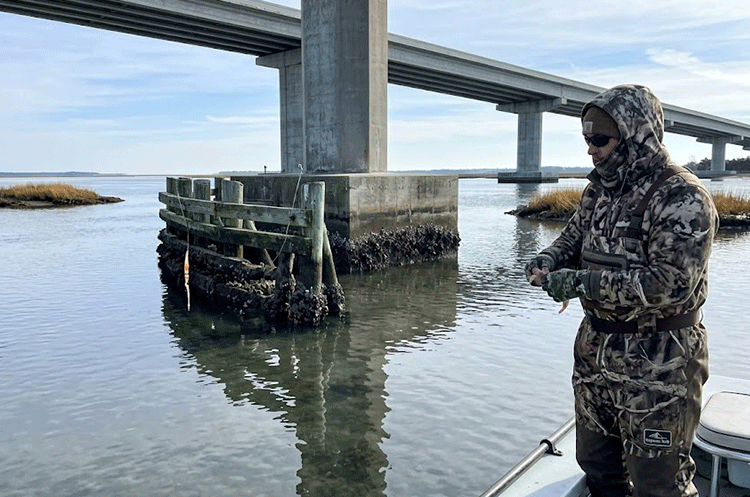
- Structure Near the Intracoastal Waterway (ICW): Deep-water residential dock pilings, vertical concrete bridge buffers (particularly the central supports flanking the Surf City High Rise Bridge), and submerged oyster bars adjacent to primary channels provide stable refuge. Heavy concrete and dark wooden pilings slowly absorb and radiate thermal energy into the surrounding water column while offering a critical break from high-velocity winter currents.
Local Trophic Connection: Because tidal velocity directly controls how water pushes over these shallow solar shelves and shifts temperatures inside deep basins, mapping your trips around active current stages is paramount. To master how water dynamics position these late-winter schools, review our foundational anchor analysis, What Tide is Best for Fishing Around Topsail.
Proven February Tactics and Rigs: Mastering the "Dead-Stick"
The single most critical rule of February angling is to drastically slow down your manual retrieve cadence. A redfish's digestive system operates at a near-standstill in winter water, meaning they will refuse to expand critical caloric energy to chase down a moving bait. Your presentation must sit virtually stationary to trigger an instinctual reaction strike. This is the arena of a highly technical method known as "Dead-Sticking."
1. The "Dead-Stick" Soft Plastic Presentation
To execute this tactic perfectly, downsize your lure selections to small $3\text4\text$ soft plastic paddle tails or scent-infused shrimp profiles—such as a Z-Man ElaZtech minnow or a classic Gulp! Shrimp. Pin the plastic to an exceptionally light $1/16\text$ or $1/8\text$ short-shank jighead. A heavy jighead crashes into the mud too violently, instantly spooking fish in ultra-clear water. Cast the rig softly toward a known winter hole or flat, allow it to sink completely to the bottom, and let it sit completely motionless for 15 to 30 seconds. Every half-minute, give your rod tip a subtle, microscopic twitch—moving the lure mere inches—and let it settle back into the mud. A cold-water February bite will virtually never feel like a violent thump; your line will simply feel slightly heavy or begin slowly tracking sideways.
2. Live and Fresh Bait Strategies
When the artificial lure bite slows down due to severe cold fronts, natural forage remains an absolute lifesaver. Free-lining a fresh piece of cut local shrimp or a small live mud minnow near deep piling bases or oyster shelves produces excellent results. Minimize your terminal weight completely; use a light split-shot or a micro-weight Carolina rig featuring an $8\text12\text$ clear fluorocarbon leader line. The low refractive index of fluorocarbon makes it completely invisible to line-shy winter redfish, ensuring your presentation looks completely detached from any fishing line.
| Winter Presentation | Optimal Structure Zone | Retrieval Cadence Specification | Technical / Tactical Advantage |
|---|---|---|---|
| Scented Shrimp (Gulp!) on $1/16\text$ Jig | Deep muddy creek holes & bends | Dead-stick for 30 seconds, micro-twitch | Scent trail triggers blind feeding reactions in dark mud |
| Weedless Paddletail (Z-Man) | Shallow sun-warmed mud flats | Ultra-slow crawl with extended pauses | Swims cleanly over shallow flats without snagging weeds |
| Free-Lined Fresh Cut Shrimp | Bridge pilings & deep ICW docks | Natural current drift with zero added lead | Zero line resistance for highly timid winter drum |
Ethical Cold-Water Handling: Preserving the Winter Inshore Stock
During the month of February, native red drum are highly vulnerable to environmental stress due to their depressed metabolic states. Fighting a fish on overly light tackle causes an excessive buildup of toxic lactic acid in their muscles, from which they recover much slower in cold water. Scale up your rod selections to medium-action configurations to bring fish to the net quickly, preventing terminal physical exhaustion.
Always utilize inline circle hooks or pinch down the barbs on your artificial hooks to ensure hook extraction is fast and tissue damage is kept to an absolute minimum. Avoid lifting out-of-season puppy drum onto freezing fiberglass boat decks or dry sand, as this completely destroys their protective mucus slime layer, leaving them highly susceptible to lethal winter fungal infections. Handle every fish with thoroughly wet hands, keep them submerged in the water column as much as possible for field photography, and revive them patiently facing into the current until they swim out of your hand under their own power.
Book a Winter Drum Specialist
Successfully navigating volatile, low-water tidal marsh creeks in freezing conditions, avoiding hidden oyster mounds, and identifying hyper-localized winter redfish schools carries an incredibly steep learning curve for visiting anglers. Hiring an experienced, licensed local charter guide ensures you completely skip the grueling cold-weather scouting phases, stepping directly onto custom-rigged vessels equipped with specialized light tackle setups and the finest bait sources available. Explore our verified, comprehensive Topsail Island Charter Captains Directory to partner with a premier winter inshore specialist and book your February excursion today!
Plan Your Next Season on the Water
Every month offers something different around Topsail Island. Continue exploring seasonal fishing patterns, current fishing activity, weather and tide conditions, species guides, and experienced local captains to help you make the most of your next trip.
🎣 Planning a trip to the NC coast? Before you book a boat down south, check out why Topsail vs. Wilmington fishing offers a better backwater experience. 🎣

Are you a Topsail Area Captain?
Grow your charter business with an SEO-optimized listing in our directory. For just $12/month, we help you reach more anglers and secure the consistent bookings you need to thrive.