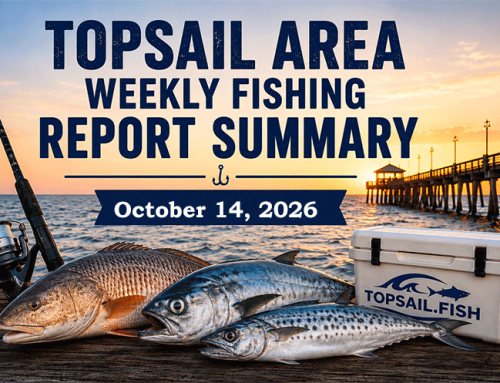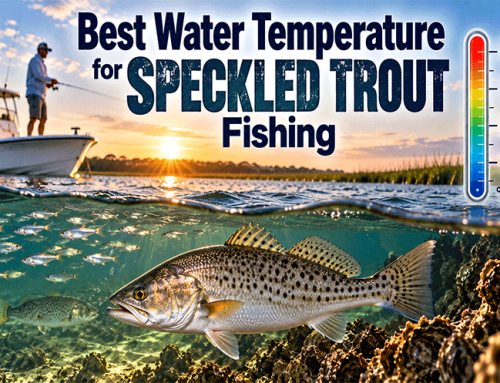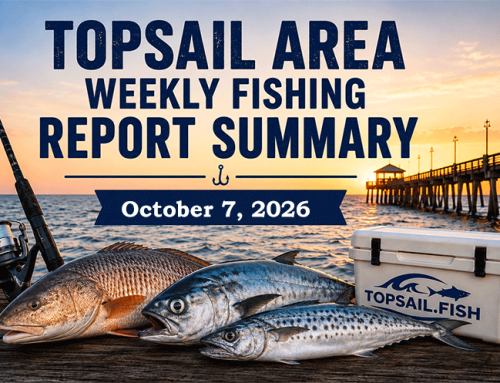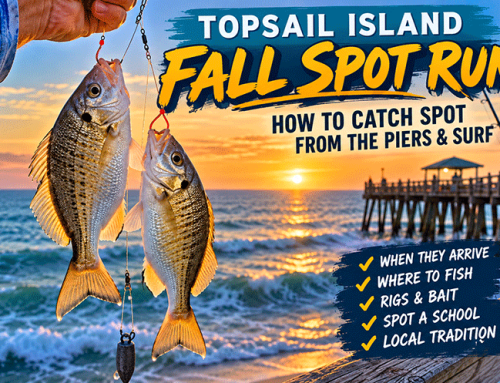
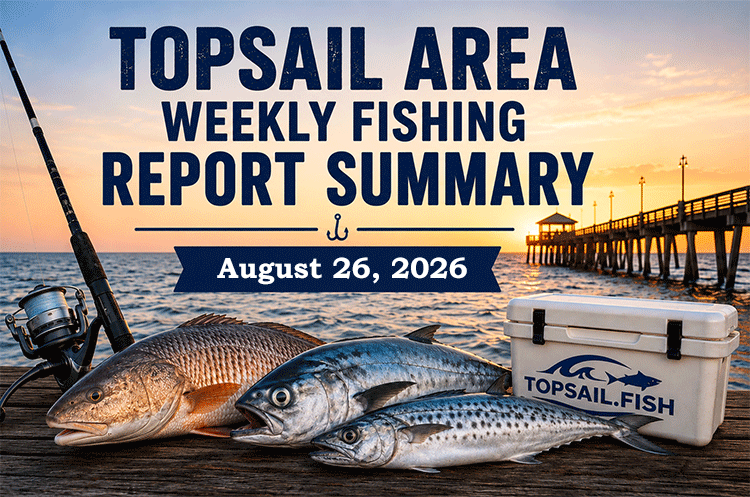
Topsail Area Weekly Fishing Summary is our roundup of regional fishing activity, pier and surf action, seasonal trends, and the fishing outlook from across Topsail Island, Surf City, North Topsail Beach, Sneads Ferry, and the surrounding coastal waters.
The final week of August is beginning to show the first real signs of the seasonal transition toward fall. Finger mullet and other baitfish are becoming increasingly important around the inlets, marshes, creeks, and beachfront, and predators are responding. Red drum remain the strongest inshore target, flounder continue to show in good numbers, Spanish mackerel and bluefish are active near the beaches, and sheepshead remain dependable around hard structure. Offshore, anglers continue finding king mackerel, mahi, grouper, snapper, and other bottom species during favorable weather windows.
There were no new captain fishing reports submitted directly to Topsail.Fish this past week, so this summary is based on current regional catches, pier activity, seasonal movement, and recent fishing conditions throughout the greater Topsail area.
Species Scorecard
- Red Drum ★★★★★
- Spanish Mackerel ★★★★★
- Flounder ★★★★☆
- Sheepshead ★★★★☆
- Bluefish ★★★★☆
- Speckled Trout ★★★☆☆
- Black Drum ★★★☆☆
- King Mackerel ★★★☆☆
Red Drum Remain the Strongest Inshore Target
Red drum continue to provide the most dependable inshore action throughout the Intracoastal Waterway, creeks, marsh shorelines, oyster areas, docks, and shallow flats. The best artificial-lure bite remains early, before increasing sunlight and boat traffic push fish toward deeper or more protected water.
Topwater plugs, gold spoons, paddle tails, and shrimp imitations are all good choices during the first few hours of daylight. Anglers should pay particular attention to grass points, creek mouths, marsh drains, and shallow areas where finger mullet are moving.
As the sun rises, live finger mullet, live shrimp, cut mullet, and fresh menhaden become more dependable. Docks, shaded banks, oyster edges, deeper creek bends, and areas where current funnels bait can all hold fish later in the morning.
Late August is also a good time to watch the inlets. Increasing bait movement can draw red drum toward shoals, deeper channels, and current seams where mullet and shrimp are being swept out of the backwaters.
Flounder Continue to Show in Good Numbers
Flounder remain widespread around creek mouths, marsh drains, docks, bulkheads, channel edges, inlet areas, and other places where moving water carries bait across the bottom.
Live finger mullet and mud minnows remain excellent bait choices, while paddle tails, bucktails, scented soft plastics, and jig heads can all produce when worked slowly enough to maintain bottom contact.
Current edges remain especially important. A small drop beside a marsh drain or creek mouth can hold several fish even when surrounding water appears relatively featureless.
With North Carolina’s recreational flounder season approaching September 1, anglers should be sure they understand the current harvest rules before planning to keep fish.
Speckled Trout Still Producing During Low-Light Periods
Speckled trout remain part of the late-summer inshore mix, particularly around larger creeks, river areas, deeper holes, current seams, and inlet channels.
Topwater plugs remain worth throwing around sunrise, especially around grass points and areas where shallow water borders deeper channels. Once the sun rises, live shrimp beneath popping corks and soft plastics worked slowly along channel edges become more reliable.
Trout may be scattered rather than concentrated in large schools, so anglers should cover water until they identify a productive depth, current speed, or shoreline pattern.
Black Drum Holding Around Structure
Black drum continue to show around bridges, docks, oyster beds, deeper holes, and other areas holding shrimp, crabs, and shellfish.
Fresh shrimp remains the most versatile bait, particularly when fished close to the bottom around shaded structure or deeper water. Small pieces of shrimp are often more effective than oversized baits when fish are feeding on smaller crustaceans.
Black drum can remain active later in the day, making them a useful target after the early red drum and trout bite begins to slow.
Sheepshead Remain Strong Around Pilings and Bridges
Sheepshead continue to provide excellent action around bridge supports, dock pilings, pier structure, bulkheads, and other barnacle-covered hard structure.
Fiddler crabs, sand fleas, barnacles, and live shrimp remain the best bait options. Keep the presentation extremely close to the structure and maintain direct contact with the bait.
Sheepshead bites can be subtle, often feeling like little more than added weight or a slight change in line tension. Quick reactions and a strong hookset are important before the fish turns back toward the piling.
Spanish Mackerel Continue to Dominate the Nearshore Bite
Spanish mackerel remain one of the strongest late-August targets along the Topsail beachfront, near inlet shoals, and around hard-bottom areas within several miles of shore.
Trolling small Clarkspoons behind planers or trolling weights remains one of the most dependable ways to locate fish. Anglers should vary lure depth and trolling distance until they find the most productive part of the water column.
When birds begin working or fish start breaking the surface, casting metal jigs and small spoons can provide fast action. Late August often brings a better class of Spanish mackerel, so anglers should be prepared for larger fish mixed into the schools.
Bluefish Following the Bait Around the Inlets
Bluefish remain mixed with Spanish mackerel near the beaches and are becoming increasingly noticeable around inlet mouths as bait concentrations grow.
Gotcha plugs, spoons, diamond jigs, small topwater lures, and cut bait can all produce. Bluefish frequently attack the same schools of bait as Spanish mackerel, so anglers using very light leaders should expect occasional bite-offs.
Outgoing tides can be particularly interesting as bait is flushed from the inlets and creek systems toward open water.
Surf Fishing Starting to Benefit From Increasing Mullet Activity
Surf anglers continue to find whiting, black drum, croakers, spots, bluefish, small sharks, and occasional red drum. Increasing finger mullet activity should begin making the surf more interesting as the calendar approaches September.
Fresh shrimp and sand fleas remain excellent choices for whiting and black drum. Anglers targeting red drum or larger bluefish should consider fresh cut mullet or menhaden on Carolina-style rigs.
The biggest key is finding structure. Deeper troughs, sloughs, cuts through the sandbar, and places where the wave pattern changes are all potential feeding areas.
Do not automatically make the longest cast possible. Fish often travel through the first trough surprisingly close to shore, especially around higher water or when bait is moving along the beach.
How Reading the Surf Can Put More Fish in Front of You
As late-summer bait begins moving more consistently along the beaches, understanding the shape of the surf becomes increasingly important. Sandbars, sloughs, cuts, points, and deeper pockets create natural travel lanes and feeding zones for red drum, bluefish, sea mullet, flounder, and other species.
Anglers who learn to identify where waves break over shallow bars and where they stop breaking over deeper water can make much more intentional casts instead of simply throwing bait as far as possible.
That skill becomes even more valuable as the finger mullet migration strengthens and predators begin using those deeper cuts and troughs to ambush bait moving along the shoreline.
Pier Fishing Offers a Broad Late-Summer Mix
Topsail-area piers continue to offer a wide range of opportunities. Bottom fishermen are catching whiting, spots, croakers, black drum, and occasional red drum, while anglers casting artificial lures continue finding Spanish mackerel and bluefish.
Gotcha plugs and casting metals remain the standard choices for Spanish mackerel during early morning and late afternoon periods when bait moves close to the pier.
Sheepshead remain available around pilings, while live-bait anglers fishing from the ends of the piers remain in the game for king mackerel, cobia, and the occasional tarpon.
Finger Mullet Becoming the Most Important Story of the Season
The continuing increase in finger mullet may be the single most important development heading into September. These baitfish are reaching ideal forage size and moving more noticeably through marshes, creeks, the ICW, inlets, and beachfront waters.
Red drum, flounder, speckled trout, bluefish, Spanish mackerel, and larger predators all respond to concentrated mullet schools.
Anglers should watch for bait suddenly becoming nervous, spraying from the water, compressing against shorelines, or moving rapidly through creek mouths and inlet channels.
Those signals often reveal feeding predators before the fish themselves become visible.
King Mackerel Still Available Around Bait and Structure
King mackerel continue to be found around nearshore reefs, wrecks, bait schools, and deeper offshore structure.
Slow-trolling live menhaden, bluefish, or cigar minnows remains one of the most productive approaches. Drone spoons, strip baits, and deep-diving plugs can also produce when live bait is difficult to locate.
Finding bait remains more important than targeting one particular depth. Menhaden schools, working birds, temperature changes, and bait marked around structure are all worth investigating.
Mahi and Offshore Bottom Fishing Remain Productive
Mahi remain available around weed lines, floating debris, temperature breaks, and offshore bait concentrations. Smaller school-sized fish continue to make up much of the catch, but their numbers can provide excellent action when anglers locate a productive concentration.
Small trolling skirts, rigged ballyhoo, mahi chains, and swimming plugs can all produce. Keep a spinning rod ready when a hooked fish approaches the boat because additional mahi may follow.
Offshore bottom fishermen continue to find grouper, black sea bass, vermilion snapper, triggerfish, grunts, porgies, amberjack, and other structure-oriented species around hard-bottom areas, reefs, wrecks, and ledges.
What to Expect Next Week
The growing finger mullet movement should begin strengthening several fisheries as September approaches. Red drum should remain the most dependable inshore target, with flounder, speckled trout, black drum, and sheepshead continuing to provide additional opportunities.
Spanish mackerel and bluefish should remain strong along the beachfront and around inlet areas, especially during outgoing tides that carry bait toward open water.
Surf anglers may begin seeing more noticeable red drum and bluefish activity as mullet schools increase, while pier anglers should continue finding Spanish mackerel, bluefish, bottom species, and occasional larger predators.
Offshore anglers can expect continued opportunities for king mackerel, mahi, grouper, snapper, and other bottom fish during favorable weather windows.
Topsail.Fish Weekly Takeaway
The key this week is to follow the bait. Finger mullet, shrimp, and small schooling baitfish are connecting nearly every productive fishery around Topsail Island.
Start early for red drum, trout, and flounder. Look for concentrated bait around creek mouths and inlets. When fishing the beach, read the surf before choosing where to cast. Late August rewards anglers who pay attention to structure, current, and bait movement rather than relying on one favorite location.
Best Bets for the Coming Week
Best Inshore Bet: Red Drum
Target grass edges, oyster points, creek mouths, docks, and shallow flats around first light. Use topwater plugs or soft plastics early, then switch to live finger mullet, shrimp, or fresh cut bait later in the morning.
Best Flounder Bet: Creek Mouths and Marsh Drains
Slowly work live finger mullet, mud minnows, or soft plastics along bottom transitions where moving water carries bait into deeper channels.
Best Structure Bet: Sheepshead
Fish fiddler crabs, sand fleas, barnacles, or live shrimp directly beside bridge supports, dock pilings, and pier structure.
Best Surf Fishing Bet: Red Drum
Look for deeper troughs, cuts, and sloughs holding finger mullet, then fish fresh cut mullet or menhaden on a Carolina-style rig.
Best Pier Bet: Spanish Mackerel
Cast Gotcha plugs and metal jigs during early morning and late afternoon when bait schools move close to the pier.
Best Nearshore Bet: Spanish Mackerel
Troll Clarkspoons around working birds, inlet shoals, hard-bottom areas, and concentrated bait, with casting tackle ready when fish begin feeding on the surface.
Best Offshore Bet: Bottom Fishing
Target hard-bottom areas, reefs, wrecks, and ledges for grouper, vermilion snapper, triggerfish, black sea bass, grunts, porgies, and other structure-oriented species.
Weekly Wildcard Prediction
Watch for the first major push of red drum and bluefish into the surf and inlet areas as finger mullet schools become more concentrated. One strong outgoing tide combined with a dense mullet school could produce some of the fastest action of the late-summer season.
Topsail.Fish Forecast Rating
Overall Fishing Outlook: ★★★★☆ (4 out of 5)
Late August is providing excellent variety, but the bigger story is what comes next. Growing bait concentrations suggest the Topsail fishery is beginning its transition toward one of the most productive periods of the year.
Planning a Topsail Fishing Trip?
Browse the Topsail Island Fishing Season Guide to see how the local fishery changes throughout the year and which species typically peak each month.
Families and first-time anglers can explore our Kid-Friendly Fishing Trips for accessible fishing ideas and tips for making a day on the water more enjoyable for younger anglers.
For additional rigs, techniques, bait presentations, and practical fishing advice, visit the Topsail.Fish How-To Articles.
Ready to fish with a local professional? Browse the Topsail-area captain directory and Book a Charter for your next inshore, nearshore, or offshore fishing trip.
Fishing Intel Spotlight: How to Read the Surf
This week’s featured Topsail.Fish article focuses on one of the most valuable skills a surf angler can learn: recognizing the underwater structure hidden beneath breaking waves.
How to Read the Surf explains how sandbars, sloughs, troughs, cuts, points, pockets, and moving water reveal where fish are most likely to travel and feed. Instead of casting blindly into open water, anglers can use wave patterns and surface conditions to identify deeper lanes and natural ambush points.
The timing could not be better. As finger mullet movement increases and red drum, bluefish, flounder, and other predators begin concentrating around beachfront structure, knowing how to read the surf can make the difference between simply fishing the beach and actually targeting productive water.
For weekly fishing summaries, captain fishing reports, seasonal planning, species guides, and more local resources, visit the Topsail Island Fishing Intel Center.
Turn This Week’s Fishing Report Into Your Next Catch
Now that you’ve seen what’s happening around Topsail Island, take the next step by exploring detailed captain reports, checking seasonal fishing patterns, reviewing current conditions, and finding a local guide to help make your next trip a success.
🎣 Planning a fishing trip to coastal North Carolina? Before choosing a charter destination, discover why many anglers prefer Topsail Island’s less crowded waters, productive back bays, and outstanding inshore and surf fishing opportunities.
🎣 Planning a trip to the NC coast? Before you book a boat down south, check out why Topsail vs. Wilmington fishing offers a better backwater experience. 🎣
Own a Fishing Charter Around Topsail Island?
Get your business in front of local anglers searching for fishing charters, guides, and inshore adventures on Topsail.Fish. Our directory listings are designed to help captains improve online visibility, increase bookings, and build a stronger local presence.
Professional listings start at just $12/month.