As the intense heat of summer fades across coastal North Carolina, a dramatic transformation occurs along the beaches, marshes, and waterways of Topsail Island. Late September through November brings cooler crisp mornings, clearing water, and the single most anticipated event on the local angling calendar: the autumn red drum run. During this magical season, redfish (Sciaenops ocellatus) undergo a massive feeding frenzy as they prepare for winter, providing world-class fishing opportunities across our entire island.
Whether you are sight-casting to schooling redfish in the shallow marsh creeks behind Surf City, targeting massive “bull” drum in the churning surf of North Topsail Beach, or working structure along the Intracoastal Waterway, fall delivers the highest catch rates and largest fish of the year. In this authoritative guide, we will break down seasonal drum behavior, essential gear setups, proven tactics, and the specific local spots to help you lock into Topsail’s premier autumn fishery.
The Autumn Shift: Understanding Fall Red Drum Behavior
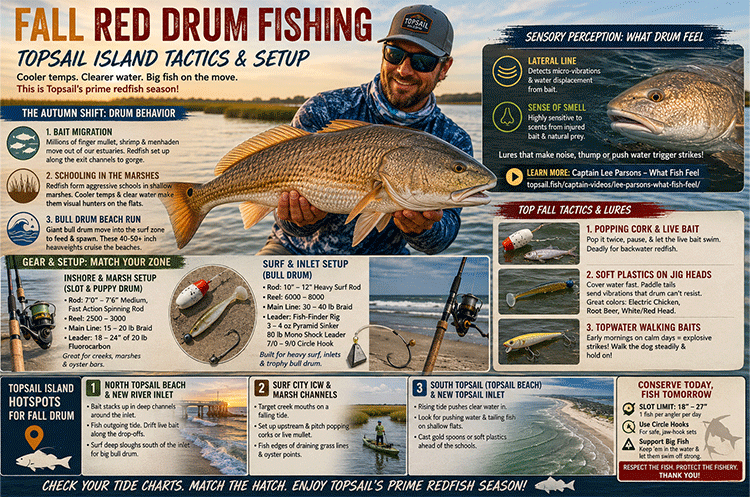
To consistently catch fall red drum, you must understand what drives their movement during the seasonal transition. Unlike mid-summer when high water temperatures force fish into deep shade or early morning feeding windows, autumn triggers two distinct biological drives: migration and hyper-phagia (intense feeding to store calories).
1. Bait Migration (The Conveyor Belt of Food)
During the fall, millions of finger mullet, shrimp, and menhaden (pogy) begin their massive exodus out of local estuaries, moving through Topsail’s backwaters and pouring out of New River and New Topsail Inlets into the ocean. Red drum set up automated ambush stations along these exit channels, waiting to gorge on the migrating bait.
2. Schooling up in the Marshes
In the backwater sounds and spartina marshes, redfish shed their summer solitary habits and form dense, aggressive schools ranging from a dozen to several hundred fish. As the water clears up with dropping temperatures, these fish become increasingly visual hunters on shallow mudflats.
3. The Bull Drum Beach Run
While puppy drum (fish under the 18 to 27-inch North Carolina slot limit) dominate the backwaters, fall brings giant adult “bull” drum (often 40 to 50+ inches and weighing 30 to 50 pounds) straight into the surf zone. Moving down the coast to spawn and feed, these heavyweights cruise just beyond the breaker lines and inside deep sloughs along Topsail’s oceanfront.
Sensory Perception: Presenting Lures That Trigger Strikes
Red drum are uniquely engineered for bottom and mid-water hunting. Understanding how they detect food in moving, sometimes murky coastal water is the secret to choosing the right presentation.
While visual cues matter greatly in clear fall water, a red drum’s lateral line and sense of smell are its primary tools for locating prey. Their lateral line detects micro-vibrations and water displacement generated by swimming baitfish or popping shrimp. This is why artificial lures that emit sound, thump, or push water are so overwhelmingly effective during the autumn feeding spree.
For an expert look at how fish interpret these environmental signals, check out our featured breakdown on Captain Lee Parsons: What Fish Feel. Captain Lee breaks down the precise sensory mechanics fish use to track prey, giving you a distinct advantage when deciding between a heavy-vibration paddle tail, a noisy popping cork, or natural scent presentation.
Gear & Setup: Equipping for Topsail Red Drum
Because fall red drum range from 2-pound backwater slot fish to 40-pound ocean monsters, your gear must match the specific zone you plan to fish.
1. Inshore & Marsh Setup (Slot & Puppy Drum)
For navigating the shallow creeks and sound-side oyster bars, a fast-action medium setup offers the perfect balance of casting accuracy and backbone.
- Rod: 7’0” to 7’6” Medium power, Fast action graphite spinning rod.
- Reel: 2500 to 3000 size spinning reel.
- Main Line: 15 lb to 20 lb braided line for superior sensitivity and distance.
- Leader: 18 to 24 inches of 20 lb fluorocarbon leader. High abrasion resistance is mandatory around sharp oyster beds.
2. Surf & Inlet Setup (Bull Drum)
Tackling massive ocean drum from the beach requires heavy-duty tackle capable of casting heavy weights into strong longshore currents and holding the bottom.
- Rod: 10’0” to 12’0” Heavy power surf rod capable of throwing 4 to 8 oz of lead plus bait.
- Reel: 6000 to 8000 size spinning reel with a smooth, heavy drag system.
- Main Line: 30 lb to 40 lb braided line.
- Leader Rig: Standard “Fish-Finder” rig (sliding sleeve with 3 to 4 oz pyramid sinker) attached to a short, 80 lb monofilament shock leader and a 7/0 to 9/0 non-offset circle hook (to ensure safe, legal release of oversized fish).
Top Fall Tactics & Lure Selections
During autumn, drum are aggressive, but matching the prevailing bait pattern is key to maximizing your strikes.
When targeting these schooling fall drum around the sloughs, you will get the best results using a standard Saltwater Carolina Rig tipped with fresh cut bait or live Topsail Island Sand Fleas.
1. The Popping Cork & Live Bait Combination
This is arguably the most lethal technique for backwater fall drum. A cupped popping cork creates a loud “chugging” sound that perfectly simulates a feeding redfish or jumping trout, drawing fish from yards away.
- How to Rig: Tie 18 to 24 inches of 20 lb fluorocarbon below a weighted popping cork, terminating in a 2/0 wide-gap circle hook.
- Bait: Hook a live 3 to 4-inch finger mullet through the lips, or a live mud minnow/shrimp under the horn.
- Action: Pop the cork sharply twice, pause for 5 to 10 seconds, and allow the live bait to swim beneath it. Most strikes occur during the pause.
2. Soft Plastics on Heavy-Vibration Jig Heads
When covering water rapidly along marsh banks and creek edges, throw soft plastic paddle tails on a 1/4 oz to 3/8 oz jig head. Colors like “electric chicken,” “root beer,” and classic white/red head excel in Topsail’s backwaters. As emphasized in Captain Lee’s sensory analysis, the rhythmic thumping of the paddle tail sends distinct low-frequency pulses through the lateral line, calling drum out of deep oyster pockets.
3. Topwater Walking Baits (Early Morning Magic)
On calm, cool autumn mornings, nothing beats a topwater explosion. Work a dog-walking hard bait (like a MirrOlure Top Dog or Heddon Super Spook Jr.) across shallow mudflats near creek mouths. Keep your retrieve steady, “walking the dog” rhythmically, and resist the urge to set the hook until you actually feel the weight of the fish on the line.
Local Focus: Topsail Island’s Hotspots for Fall Drum
Red drum are spread throughout the island, but three key geographic areas consistently produce the best action during the fall months.
1. North Topsail Beach & New River Inlet
The northern tip of the island is a high-energy transition zone where the massive flow of New River meets the Atlantic Ocean.
- The Setup: As falling tides pull cold water out of the river, bait concentrates heavily in the deep channels around the inlet spit.
- Tactics: Drift live menhaden or cut mullet along the drop-offs on an outgoing tide. Surf anglers can target the deep sloughs extending south from the inlet along North Topsail’s beaches for migrating bull drum.
2. Surf City ICW & Marsh Channels
The central backwaters behind Surf City feature extensive spartina grass marshes, intertidal oyster bars, and shallow mud creeks that warm up quickly under the autumn sun.
- The Setup: Target the mouths of feeder creeks emptying into the Intracoastal Waterway (ICW) on a falling tide.
- Tactics: Position your boat or kayak upstream of a creek mouth during the last two hours of the ebb tide. Pitch popping corks or live mullet right to the edge of the draining grass line, letting the current drift your bait naturally across the oyster points.
3. South Topsail (Topsail Beach) & New Topsail Inlet
The southern end of the island offers broad sandbars, shallow flats, and fast water sweeping around New Topsail Inlet toward Hampstead waters.
- The Setup: Clear ocean water floods into the sound on rising tides, making the shallow sandbars behind the southern point prime territory for sight-casting.
- Tactics: Look for “pushing water” or tailing fish across the shallow flats during the final hours of a flood tide. Cast small weedless gold spoons or soft plastic swimbaits ahead of moving schools to avoid spooking the fish.
Conservation & Safe Handling of Fall Red Drum
Because fall brings high numbers of slot fish and vulnerable breeding-size bull drum into shallow waters, proper handling is vital to preserving our local fishery.
- Know the Limits: In North Carolina waters, the slot limit for red drum is strictly 18 to 27 inches total length, with a daily bag limit of 1 fish per angler per day. All fish under 18 inches and over 27 inches must be released immediately.
- Use Circle Hooks: When fishing with live or dead bait, always use non-offset circle hooks. Circle hooks catch in the corner of the jaw, preventing lethal gut-hooking.
- Support Heavy Fish: Never hold a large bull drum vertically by its lip or gills. Always support its belly horizontally with two hands to prevent internal organ damage, and revive the fish in the water facing into the current until it swims away on its own power.
Setting Your Course
Fall red drum fishing on Topsail Island offers some of the most exciting, action-packed angling opportunities anywhere on the Mid-Atlantic coast. By matching your presentations to the natural bait migration, understanding how drum use their senses to track prey, and targeting the dynamic structure of our local inlets, beaches, and backwaters, you’ll be set up for an unforgettable autumn on the water. Rig up your rods, check your tide charts, and hit the water for Topsail’s prime redfish season.
Stay Informed and Get Involved
North Carolina’s fisheries are constantly evolving as new research, public input, and management decisions shape future regulations. Whether you support the current flounder rules or believe changes are needed, staying informed is the best way to make your voice heard. The North Carolina Division of Marine Fisheries (NCDMF) provides fisheries research, stock assessments, proclamations, and recreational fishing information. The North Carolina Marine Fisheries Commission (MFC) establishes many of the policies and regulations governing coastal fisheries and regularly accepts public comment. The North Carolina Wildlife Resources Commission (NCWRC) oversees Inland and Joint Fishing Waters and publishes regulations affecting anglers across the state. We encourage every fisherman—whether recreational or commercial—to follow these agencies, review proposed rule changes, and participate in the public process. Well-informed anglers help build better fisheries for everyone.
Keep Building Your Topsail Fishing Skills
Want to put this technique to work on your next trip? Use these Topsail.Fish resources to check current fishing activity, match your tactics to the season, review local conditions, and find more step-by-step fishing guides.
🎣 Planning a fishing trip to coastal North Carolina? Before choosing a charter destination, discover why many anglers prefer Topsail Island’s less crowded waters, productive back bays, and outstanding inshore and surf fishing opportunities.
🎣 Planning a trip to the NC coast? Before you book a boat down south, check out why Topsail vs. Wilmington fishing offers a better backwater experience. 🎣

Are you a Topsail Area Captain?
Grow your charter business with an SEO-optimized listing in our directory. For just $12/month, we help you reach more anglers and secure the consistent bookings you need to thrive.