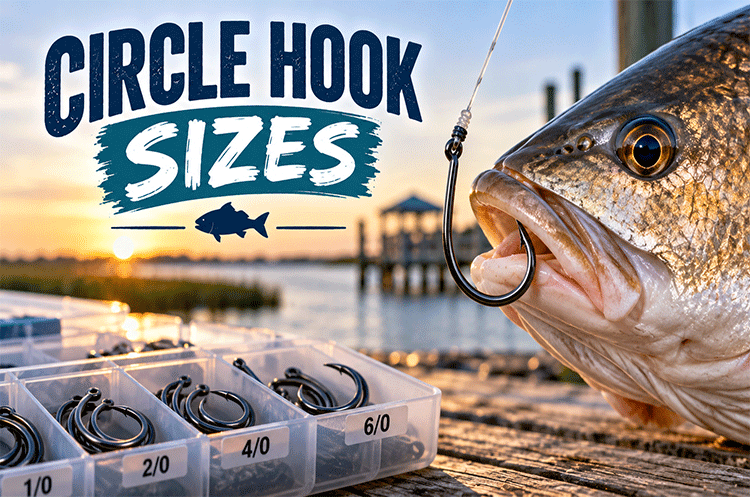
Walk into any tackle shop along Topsail Island—whether you’re stopping by native outfitters in Surf City, Sneads Ferry, or Topsail Beach—and you’ll find an entire wall dedicated to circle hooks. Thousands of packages in various shapes, wire gauges, offsets, and sizing numbers stare back at you. For many anglers, picking the right circle hook size feels like solving a secret code.
Choosing the correct circle hook size is not just a matter of personal preference; it is a fundamental mechanical requirement. Unlike traditional J-hooks, which rely on a hard, manual hookset to drive a straight point home, circle hooks operate strictly on physics and geometry. If your hook is too small, it gets swallowed, causing gut-hooking; if it’s too large, smaller target species can’t get it into their mouth, resulting in missed bites and empty coolers.
In this definitive guide, we break down the mechanics of circle hook sizing, clear up the confusing numbering systems, provide a target species matching chart, and look at how local laws and target species across Topsail Island dictate your terminal tackle.
The Mechanics of a Circle Hook: Why Size Matters
To pick the right size, you must understand how a circle hook functions. A true circle hook features a point curved at a 90-degree angle back toward the shank. When a fish eats your bait and turns away, the hook slides out of its throat without catching on soft tissue. As the eye of the hook exits the fish’s mouth, the curved point rotates into the jaw hinge, locking tightly into the corner of the lip.
This self-setting mechanical process means two factors govern your choice of hook size:
- The Gap Width: The distance between the hook point and the shank. The gap must be wider than the jawbone or lip tissue of your target species so it can slip around the corner of the mouth and bite down.
- Bait Clearance: Your chosen hook size must accommodate your bait without blocking the gap. If you jam a giant piece of cut mullet onto a small 2/0 circle hook, the bait fills the gap, preventing the point from rotating into the fish’s lip.
Deciphering Hook Sizing: The “Aught” System Explained
The single biggest point of confusion for anglers is the dual-direction sizing scale used by hook manufacturers (Mustad, Owner, Gamakatsu, Eagle Claw, etc.). Understanding this scale is key to buying the right gear.
1. Standard Numbers (Smallest to Medium Hooks)
Standard hook sizes use plain numbers: #10, #8, #6, #4, #2, #1.
The Rule: The higher the number, the smaller the hook. A tiny #10 hook is used for catching small pinfish or spot, while a #1 hook is significantly larger and suited for sea mullet (whiting) or croaker.
2. “Aught” Sizes (Large to Giant Hooks)
Once you step above a #1 hook, the sizing scale transitions into the “aught” system, designated by a slash and a zero: 1/0, 2/0, 3/0, 4/0… up to 10/0, 12/0, and beyond.
The Rule: The higher the number before the slash, the larger the hook. A 1/0 (pronounced “one-aught”) hook is small enough for puppy drum, while a 10/0 hook is designed for giant ocean bull drum or sharks.
Important Local Note: Hook sizes are not standardized across manufacturers. A Gamakatsu 4/0 Octopus Circle hook may have a smaller gap width than an Owner 4/0 Mutu Circle. Always evaluate the physical gap width of the hook rather than relying strictly on the number printed on the pack.
Avoid the #1 Mistake: Do Not Set the Hook!
You can buy the perfect circle hook size, but if your muscle memory takes over and you snap your rod back to set the hook, you will pull the terminal tackle straight out of the fish’s mouth every single time.
Improper hook-setting technique is one of the quickest ways to ruin a day on the water. For an expert breakdown of why snapping the rod ruins a circle hook’s geometric design—along with other common terminal tackle blunders—check out our featured video on Captain Lee Parsons: Angler’s Biggest Mistakes. Captain Lee explains how to let the rod load naturally so the circle hook slides directly into the corner of the jaw, ensuring a 100% solid hookup without jerk-setting.
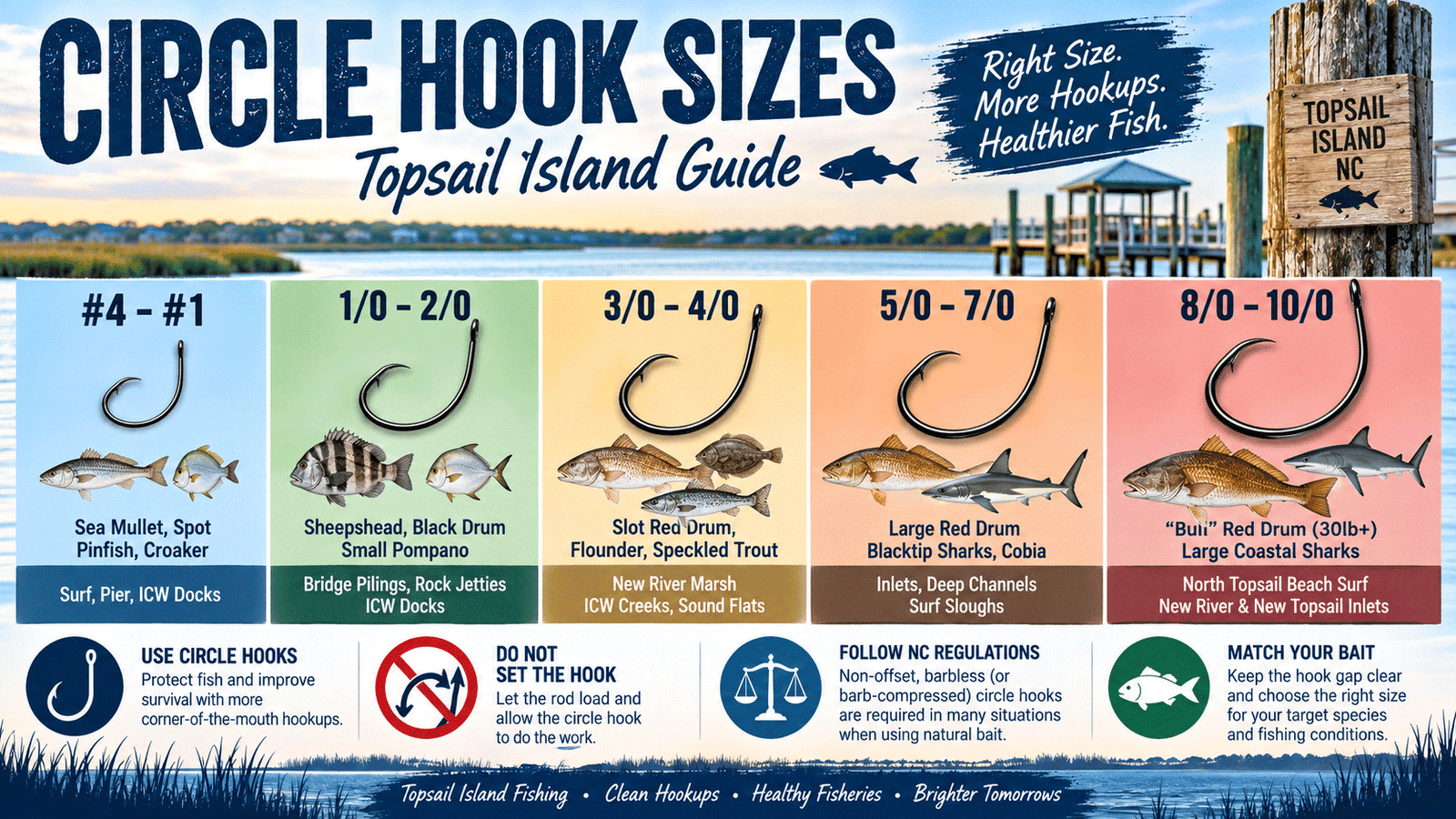
Topsail Island Target Species & Circle Hook Size Chart
To streamline your tackle box for coastal North Carolina, use this practical cheat sheet to match your hook size, target species, and ideal bait setup around Topsail Island.
| Hook Size | Target Species | Recommended Baits | Primary Local Zones |
|---|---|---|---|
| #4 to #1 | Sea Mullet (Whiting), Spot, Pinfish, Croaker | Bloodworms, Fishbites, small shrimp pieces | Surf City Pier, Beach Surf, ICW Docks |
| 1/0 to 2/0 | Sheepshead, Black Drum, Small Pompano | Fiddler crabs, live sand fleas, small fresh shrimp | Bridge Pilings, Rock Jetties, ICW Docks |
| 3/0 to 4/0 | Slot Red Drum (18″–27″), Summer Flounder, Speckled Trout | Live finger mullet, mud minnows, cut shrimp | New River Marsh, ICW Creeks, Sound Flats |
| 5/0 to 7/0 | Large Inshore Red Drum, Blacktip Sharks, Cobia | Whole live finger mullet, large cut croaker, menhaden | Inlet Mouths, Deep ICW Channels, Surf Sloughs |
| 8/0 to 10/0 | “Bull” Red Drum (30lb+), Large Coastal Sharks | Half blue crab, large menhaden heads, cut bluefish | North Topsail Beach Surf, New River & New Topsail Inlets |
Local Focus: Regulations & Conservation Around Topsail
Using proper circle hook sizes isn’t just a best practice on Topsail Island—in many scenarios, it is mandated by North Carolina law to protect our breeding fish stocks.
1. The NC Red Drum Circle Hook Mandate
North Carolina manages red drum under a strict slot limit (18 to 27 inches total length). Oversized drum—known locally as “bull drum” or “old drum”—are the protected breeding foundation of the entire fishery.
- The Rule: When using natural bait in designated waters (such as Pamlico Sound and coastal inlets during peak summer/fall seasons), anglers are required to use non-offset, barbless (or barb-compressed) circle hooks.
- Why Short Leaders Matter: To maximize the benefits of a 6/0 to 10/0 circle hook on big drum, pair it with a short leader (6 inches or less from sinker to hook). A short leader prevents the fish from swallowing the hook before the weight pulls the circle point into the corner of the mouth.
2. Non-Offset vs. Offset Circle Hooks
When shopping for circle hooks, you will notice two main styles: Demon/In-Line (Non-Offset) and Offset.
- Non-Offset (In-Line): The point is aligned perfectly parallel with the shank. This is the safest, most conservation-friendly style because it almost exclusively catches in the corner of the mouth.
- Offset: The point is bent slightly to the side of the shank. While offset hooks catch fish slightly faster, they increase the risk of gut-hooking, making them unsuitable for catch-and-release fishing on over-slot drum. Stick with non-offset circle hooks for all cut-bait fishing.
3. Wire Gauge: Fine Wire vs. Heavy Duty
Always tailor the wire strength of your circle hook to your line test and target species:
- Light Wire (e.g., Gamakatsu Light Circle): Ideal for small mouth species like sea mullet or pompano. Light wire penetrates quickly with light tackle line (8–12 lb braid) and keeps live shrimp lively.
- Heavy/Forged Wire (e.g., Owner Super Mutu): Mandatory when targeting 40-pound bull drum or sharks with 30–50 lb braid. A light wire hook will straighten out under the heavy drag pressure required to turn a massive fish in strong inlet currents.
Setting Your Course
Understanding circle hook sizing eliminates guesswork and drastically increases your hookup ratio while protecting local fish populations. Whether you are fishing tiny #2 circle hooks for whiting off Surf City Pier or rigging 8/0 non-offset hooks for bull drum at New River Inlet, matching the hook gap to your bait and target species is the mark of a true local angler. Stop setting the hook, let your gear do the work, and enjoy clean, corner-of-the-mouth releases all season long across Topsail Island.
Stay Informed and Get Involved
North Carolina’s fisheries are constantly evolving as new research, public input, and management decisions shape future regulations. Whether you support the current flounder rules or believe changes are needed, staying informed is the best way to make your voice heard. The North Carolina Division of Marine Fisheries (NCDMF) provides fisheries research, stock assessments, proclamations, and recreational fishing information. The North Carolina Marine Fisheries Commission (MFC) establishes many of the policies and regulations governing coastal fisheries and regularly accepts public comment. The North Carolina Wildlife Resources Commission (NCWRC) oversees Inland and Joint Fishing Waters and publishes regulations affecting anglers across the state. We encourage every fisherman—whether recreational or commercial—to follow these agencies, review proposed rule changes, and participate in the public process. Well-informed anglers help build better fisheries for everyone.
Keep Building Your Topsail Fishing Skills
Want to put this technique to work on your next trip? Use these Topsail.Fish resources to check current fishing activity, match your tactics to the season, review local conditions, and find more step-by-step fishing guides.
🎣 Planning a fishing trip to coastal North Carolina? Before choosing a charter destination, discover why many anglers prefer Topsail Island’s less crowded waters, productive back bays, and outstanding inshore and surf fishing opportunities.
🎣 Planning a trip to the NC coast? Before you book a boat down south, check out why Topsail vs. Wilmington fishing offers a better backwater experience. 🎣
Own a Fishing Charter Around Topsail Island?
Get your business in front of local anglers searching for fishing charters, guides, and inshore adventures on Topsail.Fish. Our directory listings are designed to help captains improve online visibility, increase bookings, and build a stronger local presence.
Professional listings start at just $12/month.