
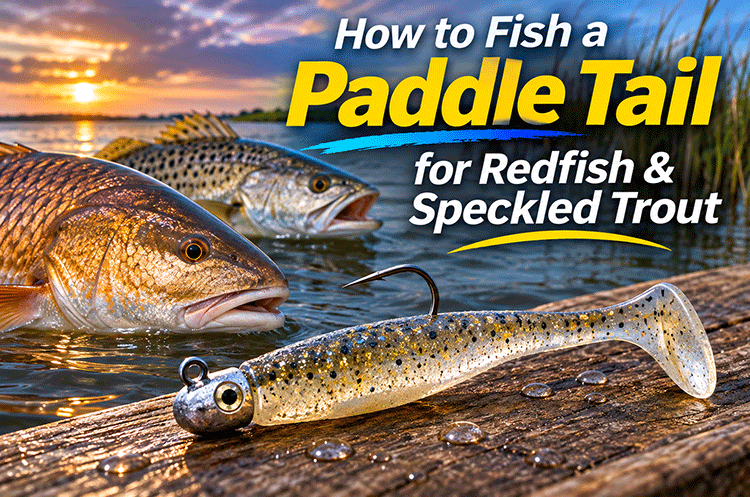
How to Fish a Paddle Tail for Redfish & Speckled Trout
There’s a reason paddle-tail soft plastics are among the most popular artificial lures for inshore fishing. They’re simple, versatile, relatively inexpensive and capable of catching everything from shallow-water red drum to speckled trout holding along deeper channel edges.
But there’s a difference between casting a paddle tail and knowing how to fish one effectively.
Many anglers simply cast and reel, hoping a hungry fish will chase the lure. While that approach sometimes works, learning to control the lure’s depth, retrieve speed and movement can dramatically improve your chances of getting a strike.
Around Topsail Island, where tidal currents, marsh creeks, oyster bars and Intracoastal Waterway channels create constantly changing conditions, understanding how to fish a paddle tail is one of the most useful skills an inshore angler can develop.
Whether you’re targeting redfish along a shallow grass line or speckled trout near a creek mouth, the same soft-plastic lure can produce results with just a few adjustments.
Here’s how to make those adjustments and get more from every cast.
What Is a Paddle-Tail Lure?
A paddle tail is a soft-plastic fishing lure with a flexible tail shaped like a small paddle. As the lure moves through the water, the tail swings from side to side, creating vibration and a swimming action that imitates baitfish.
Most inshore paddle tails resemble small mullet, minnows, menhaden or other forage fish commonly found in coastal waters.
Unlike many hard baits, paddle tails can be rigged with different jig heads or weedless hooks, allowing anglers to adjust their presentations for water depth, current and structure.
For speckled trout and red drum, a 3- to 4-inch paddle tail is an excellent starting size.
Smaller profiles may be useful when fish are feeding on tiny baitfish, while larger profiles can help when predators are targeting bigger forage.
The lure’s greatest advantage is versatility. With the right retrieve, one paddle tail can imitate a baitfish swimming steadily, struggling near the bottom or drifting naturally through a tidal current.
How to Rig a Paddle Tail Correctly
Even the best paddle tail won’t perform properly if it’s rigged crooked.
When mounting a soft plastic on a jig head, the lure should sit straight along the hook shank, with the tail free to move naturally.
Step 1: Match the Hook to the Lure
Choose a jig head with a hook long enough to provide good hook placement without extending so far into the body that it restricts the tail’s movement.
For a typical 3- to 4-inch paddle tail, the correct hook size depends on the lure’s body shape and the jig-head design.
Step 2: Measure the Hook Exit Point
Before inserting the hook, hold the jig head alongside the lure and identify where the hook should exit the back.
This prevents the lure from bunching up or bending during rigging.
Step 3: Thread the Lure Straight
Insert the hook through the center of the lure’s nose and carefully thread the body along the hook shank.
Bring the hook point out at the measured location and slide the lure firmly against the jig head.
Step 4: Check the Alignment
Look at the lure from above and from the side. The body should be straight, not curved or twisted.
A crooked paddle tail may roll, swim sideways or produce an unnatural action.
Before making your first cast, swim the lure beside the boat or shoreline and confirm that the tail moves freely.
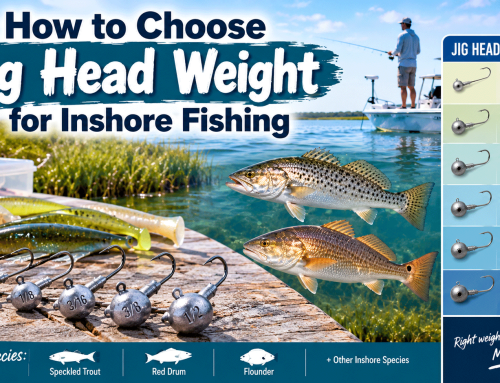
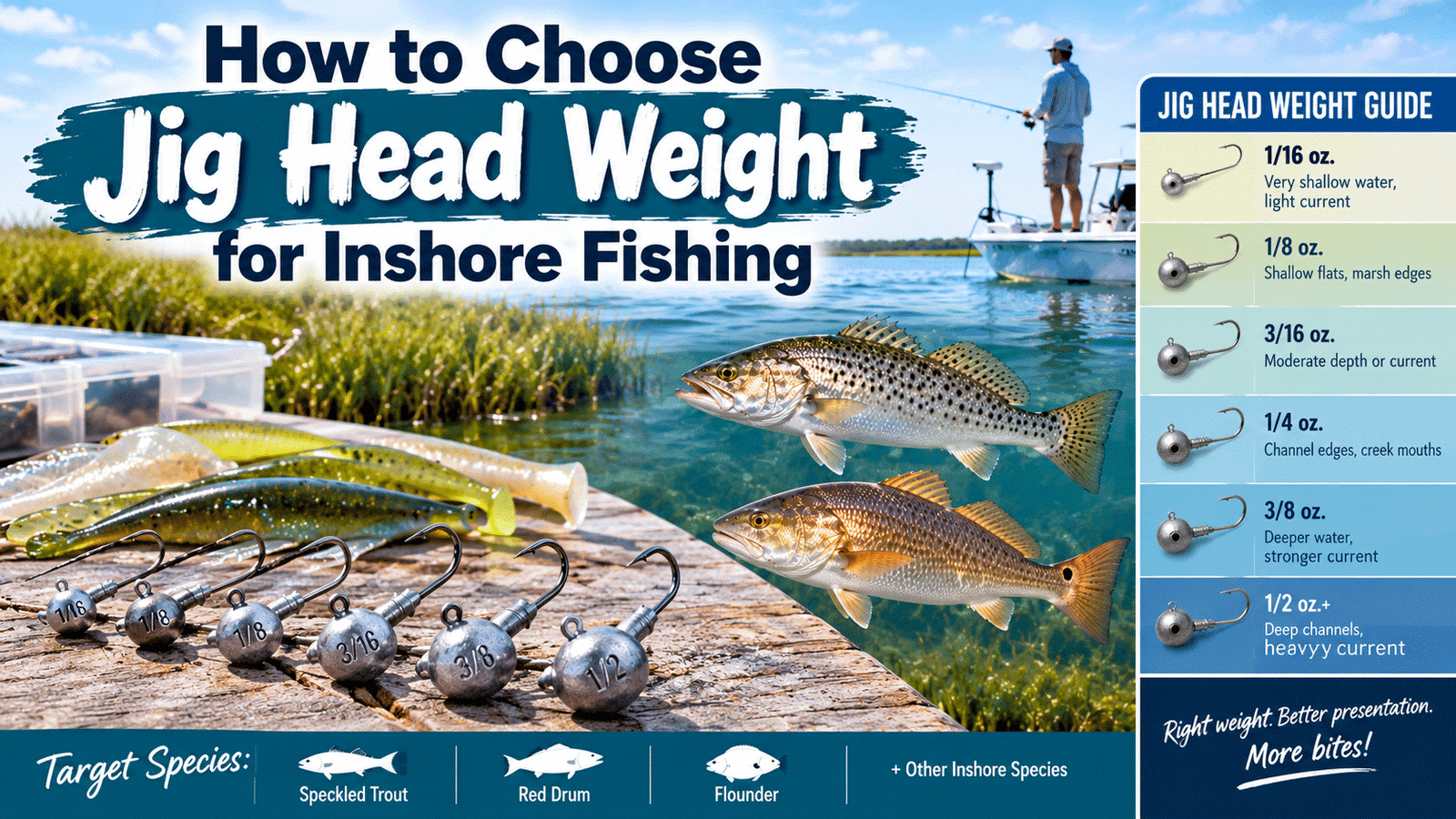
Choosing the Right Jig Head Weight
Jig-head weight determines how quickly your paddle tail sinks and how easily you can control its depth in moving water.
For many shallow-water situations around Topsail Island, 1/8-ounce and 1/4-ounce jig heads are useful starting choices.
A 1/8-ounce head can work well along shallow marsh edges, protected flats and areas with light current.
A 1/4-ounce head often provides better control around creek mouths, channel edges and moderate tidal flow.
In deeper water or stronger current, a 3/8-ounce head may be appropriate.
However, heavier isn’t automatically better.
Use the lightest jig head that allows your lure to reach the intended depth while maintaining a natural presentation.
A paddle tail that constantly drags through oyster shells may be too heavy. One that never reaches the fish may be too light.
Remember that your retrieve speed also affects swimming depth. A fast retrieve can lift the lure higher in the water column, even when using a relatively heavy jig head.
Five Paddle-Tail Retrieves Every Inshore Angler Should Know
The real secret to fishing paddle tails isn’t owning dozens of colors. It’s knowing how to change your retrieve to match the conditions.
1. The Slow, Steady Retrieve
This is the simplest and often one of the most effective paddle-tail presentations.
Cast beyond the area you’re targeting, allow the lure to sink to the desired depth and begin a slow, steady retrieve.
Reel just fast enough to keep the paddle tail swimming naturally.
The lure should move through the water like a baitfish traveling along a shoreline or channel edge.
This technique works especially well when red drum or speckled trout are actively feeding on moving baitfish.
Try it along marsh grass, shallow oyster edges and creek-mouth current seams.
2. The Lift-and-Fall Retrieve
When fish are holding closer to the bottom, a lift-and-fall presentation can be extremely effective.
Cast and allow the paddle tail to sink near the bottom.
Raise your rod tip gently to lift the lure, then lower the rod while recovering slack line.
The lure swims upward and then falls back toward the bottom.
Many strikes occur during the fall, so watch your line carefully for sudden movement or unexpected slack.
This presentation is particularly useful for speckled trout holding near deeper channel edges and red drum feeding around bottom structure.
3. The Twitch-and-Pause Retrieve
Sometimes fish follow a lure without committing to a strike.
Adding a brief twitch or pause can make the paddle tail appear injured or disoriented.
Begin with a steady retrieve, give the rod tip one or two short movements, then pause briefly before continuing.
The change in speed or direction may trigger a reaction strike.
Experiment with the length of the pause. During cooler conditions, a longer pause may be more effective than an aggressive retrieve.
4. The Bottom-Hopping Retrieve
For fish feeding close to the bottom, especially around sandy channel edges, a bottom-hopping retrieve can be productive.
Allow the jig to reach bottom, lift it slightly and let it settle again.
The objective is controlled movement near the bottom, not repeatedly dragging the lure through shell or debris.
Use caution around oyster beds, where exposed hooks can snag easily.
When fishing heavy oyster structure, consider swimming the lure just above the shells instead.
5. The Current-Swing Retrieve
This technique is especially useful around tidal creek mouths.
Cast up-current or across the flow and allow the moving water to carry the paddle tail along a channel edge or current seam.
Retrieve enough line to maintain contact with the lure without pulling it unnaturally against the current.
Predatory fish frequently position beside moving water, waiting for bait to pass within striking distance.
Our earlier guide, How to Fish Creek Mouths for Speckled Trout & Red Drum, explains how these current seams and feeding lanes develop around Topsail Island’s marsh systems.
How to Fish Paddle Tails for Redfish
Red drum, commonly called redfish, frequently patrol shallow marsh edges, oyster points, flooded grass and creek drains in search of shrimp, crabs and baitfish.
When targeting redfish with paddle tails, concentrate on keeping the lure close to the structure where fish are feeding.
Fish the Marsh Grass
On a rising tide, red drum may move into shallow water along flooded grass lines.
Cast parallel to the grass edge and retrieve your paddle tail slowly enough to remain near the bottom without constantly snagging vegetation.
A lightly weighted jig head or weedless presentation may be useful in particularly shallow water.
Work Oyster Points
Oyster bars create current breaks and feeding opportunities for red drum.
Rather than dragging your lure directly across exposed shell, cast along the edge where deeper water meets the oyster structure.
Allow the paddle tail to swim naturally through the area where fish may be waiting.
Our article How to Fish Oyster Bars for Red Drum & Speckled Trout provides additional guidance on identifying productive oyster edges.
Target Creek Drains
During a falling tide, small drains carry shrimp and baitfish out of the marsh.
Red drum may position near these openings to intercept food.
Cast beyond the drain and retrieve your paddle tail across the outgoing current.
Pay attention to subtle strikes. A redfish may inhale the lure without producing an aggressive hit.
How to Fish Paddle Tails for Speckled Trout
Speckled trout frequently use deeper channel edges, creek mouths, oyster points and current seams as ambush locations.
While red drum often patrol shallow structure, trout may hold farther from the shoreline or suspend above the bottom.
Find the Feeding Depth
Begin by identifying where baitfish are moving and where current creates a natural feeding lane.
Cast beyond the target and allow the paddle tail to sink before retrieving.
If you’re not getting strikes, adjust the lure’s depth before changing colors or moving to another location.
Trout may be feeding several feet above the bottom, particularly when baitfish are suspended in the water column.
Use a Controlled Retrieve
A slow, steady retrieve can be effective when trout are actively feeding.
When the bite slows, experiment with short twitches and pauses or a gentle lift-and-fall presentation.
Speckled trout often strike as the lure falls, so maintaining contact with the line is important.
Pay Attention to Water Temperature
As water temperatures cool during autumn, trout behavior and feeding patterns can change.
During periods of active feeding, trout may chase a steadily swimming paddle tail.
In colder water, slower presentations and longer pauses may produce better results.
Our Best Water Temperature for Speckled Trout Fishing guide explores how seasonal temperature changes affect trout location and feeding activity.
Choosing Paddle-Tail Colors for Topsail Island Waters
Walk into a tackle shop and you’ll find paddle tails in almost every color imaginable.
Fortunately, you don’t need every color to catch fish.
Start with a few proven color categories and adjust based on water clarity, available light and baitfish appearance.
Clear Water
Natural colors such as pearl, silver, translucent gray and baitfish patterns can be effective in clear water.
These colors imitate the small mullet, minnows and other forage fish found throughout Topsail Island’s inshore waters.
Stained Water
In moderately stained water, colors that provide a stronger silhouette or contrast may help fish locate the lure.
Chartreuse combinations, darker backs and contrasting tails are worth trying.
Low-Light Conditions
During early morning, evening or heavily overcast conditions, darker profiles may create a visible silhouette against the available light.
However, no single color works in every situation.
Before changing colors repeatedly, make sure your paddle tail is swimming at the correct depth and speed.
A properly presented lure in an ordinary color will often outperform a poorly presented lure in a supposedly perfect color.
How Tides Change Paddle-Tail Fishing
Tidal movement plays an important role in paddle-tail fishing around Topsail Island.
As water rises, red drum may move into flooded grass edges and shallow creek systems.
As water falls, baitfish and shrimp often become concentrated around creek mouths, oyster points and channel edges.
Speckled trout may position along current seams where moving water carries bait within striking distance.
During stronger current, you may need a slightly heavier jig head to maintain the intended depth.
During slack water, lighter jig heads and slower presentations may become more practical.
Rather than fishing the same retrieve throughout the tidal cycle, adjust your casting angle, weight and retrieve speed as conditions change.
Fishing Paddle Tails Around Docks and Structure
Docks along the Intracoastal Waterway can provide shade, current breaks and habitat for baitfish.
Red drum and speckled trout may use these areas when food and water movement are favorable.
Cast along dock edges, pilings and nearby channel transitions.
Allow the paddle tail to sink to the intended depth before beginning your retrieve.
A steady swimming presentation can be effective along the outer edges, while a controlled lift-and-fall retrieve may work better near deeper pilings.
Use appropriate casting angles to avoid wrapping line around structure.
When fishing close to pilings, maintain enough control to guide hooked fish away from obstructions.
How to Fish Paddle Tails During Fall and Winter
Autumn is an excellent time to fish paddle tails around Topsail Island because cooling water and seasonal bait movement can create productive feeding opportunities.
During early fall, red drum and speckled trout may respond aggressively to paddle tails retrieved through shallow feeding areas.
As temperatures continue falling, fish may shift toward deeper channels, protected creeks and locations with more stable water temperatures.
In colder conditions, try reducing retrieve speed and allowing the lure to remain in the strike zone longer.
A smaller paddle tail or lighter jig head may be helpful when fish are feeding cautiously, provided the current allows adequate depth control.
But don’t assume cold water always requires the slowest possible retrieve. Watch for baitfish activity and adjust to the fish’s response.
Seven Common Paddle-Tail Fishing Mistakes
1. Rigging the Lure Crooked
A twisted soft plastic may roll or swim unnaturally. Check alignment before casting.
2. Retrieving Too Quickly
A fast retrieve may pull the lure above the feeding zone. Slow down when fish are holding deeper.
3. Using Too Much Jig-Head Weight
An excessively heavy jig may drag along the bottom or snag oyster shells.
4. Ignoring Current Direction
Moving water affects lure depth and presentation. Cast with the current in mind.
5. Fishing Only One Depth
Fish may be suspended, near the bottom or feeding close to the surface. Experiment before leaving.
6. Changing Colors Too Often
Depth, speed and presentation frequently matter more than subtle color differences.
7. Setting the Hook Too Aggressively
Speckled trout have relatively delicate mouths. A controlled hookset with steady pressure is generally preferable to an exaggerated, forceful strike.
A Simple Paddle-Tail Fishing Plan for Topsail Island
When approaching a new inshore fishing location, use this practical process:
- Identify the structure. Look for marsh edges, oyster points, creek mouths, channel transitions or docks.
- Observe the tide. Determine whether water is rising, falling or approaching slack.
- Locate the bait. Watch for jumping shrimp, nervous baitfish, surface activity and birds feeding.
- Choose a jig-head weight. Start with enough weight to reach the desired depth while maintaining a natural presentation.
- Begin with a steady retrieve. Establish how the lure swims before experimenting with other techniques.
- Change depth and speed. Try a lift-and-fall, twitch-and-pause or current-swing retrieve if the steady presentation doesn’t produce.
- Repeat productive casts. Once you locate feeding fish, pay attention to the exact depth, retrieve and casting angle that produced the strike.
This approach helps eliminate guesswork and gives each cast a specific purpose.
What Tackle Works Best for Paddle-Tail Fishing?
You don’t need specialized or expensive equipment to fish paddle tails effectively.
A medium-light or medium-power spinning rod with a responsive tip is suitable for many inshore applications.
A spinning reel with a smooth drag, braided main line and an appropriate fluorocarbon or monofilament leader provides a versatile setup.
The ideal rod power, line strength and leader size depend on the fish you’re targeting and the structure you’re fishing.
Lighter equipment can improve lure control and sensitivity, while heavier tackle may be useful around docks, oysters or larger red drum.
Whatever equipment you choose, make sure the rod can comfortably cast the combined weight of the jig head and soft-plastic lure.
Final Thoughts: It’s All About the Presentation
Learning how to fish a paddle tail for redfish and speckled trout isn’t complicated, but it does require attention to a few important details.
Start with a properly rigged 3- to 4-inch paddle tail and a jig head suited to the depth and current.
Use a slow, steady retrieve as your starting point, then experiment with lift-and-fall, twitch-and-pause and current-swing presentations.
For red drum, focus on shallow marsh edges, oyster points and creek drains. For speckled trout, investigate current seams, deeper channel edges and areas where baitfish are concentrated.
Pay attention to changing tides, water temperatures and lure depth.
Most importantly, don’t assume a lack of strikes means you need a different lure.
Sometimes the difference between an empty cast and a solid hookup is nothing more than slowing your retrieve, changing your casting angle or letting the paddle tail sink another foot.
Master those adjustments, and a simple paddle-tail soft plastic can become one of the most dependable lures in your tackle box for fishing the waters around Topsail Island.
Stay Informed and Get Involved
North Carolina’s fisheries are constantly evolving as new research, public input, and management decisions shape future regulations. Whether you support the current flounder rules or believe changes are needed, staying informed is the best way to make your voice heard. The North Carolina Division of Marine Fisheries (NCDMF) provides fisheries research, stock assessments, proclamations, and recreational fishing information. The North Carolina Marine Fisheries Commission (MFC) establishes many of the policies and regulations governing coastal fisheries and regularly accepts public comment. The North Carolina Wildlife Resources Commission (NCWRC) oversees Inland and Joint Fishing Waters and publishes regulations affecting anglers across the state. We encourage every fisherman—whether recreational or commercial—to follow these agencies, review proposed rule changes, and participate in the public process. Well-informed anglers help build better fisheries for everyone.
Keep Building Your Topsail Fishing Skills
Want to put this technique to work on your next trip? Use these Topsail.Fish resources to check current fishing activity, match your tactics to the season, review local conditions, and find more step-by-step fishing guides.
🎣 Planning a fishing trip to coastal North Carolina? Before choosing a charter destination, discover why many anglers prefer Topsail Island’s less crowded waters, productive back bays, and outstanding inshore and surf fishing opportunities.
🎣 Planning a trip to the NC coast? Before you book a boat down south, check out why Topsail vs. Wilmington fishing offers a better backwater experience. 🎣
Own a Fishing Charter Around Topsail Island?
Get your business in front of local anglers searching for fishing charters, guides, and inshore adventures on Topsail.Fish. Our directory listings are designed to help captains improve online visibility, increase bookings, and build a stronger local presence.
Professional listings start at just $12/month.