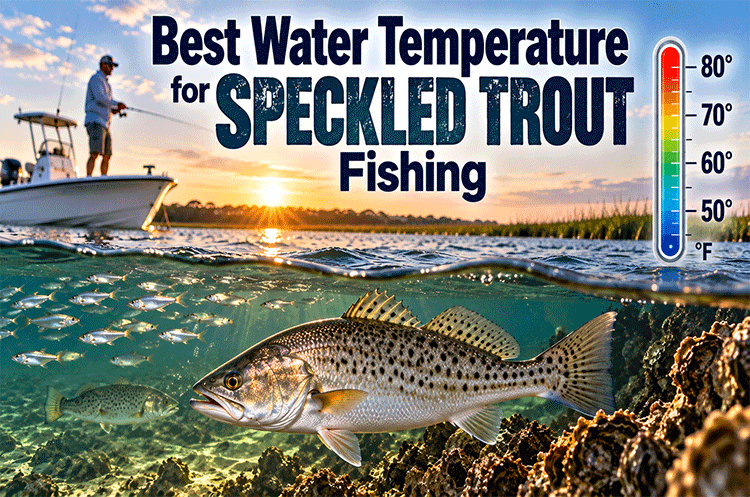
Ask anglers when the fall speckled trout bite really gets going and you’ll often hear the same answer: “When the water cools down.” That’s true—but it leaves out the most useful part of the answer. What is the best water temperature for speckled trout fishing?
For anglers around Topsail Island, water temperature can be one of the best clues for understanding where speckled trout are likely to be and how aggressively they may feed. After spending the hottest part of summer dealing with warm coastal water, trout generally become more active as autumn cooling begins. Baitfish start moving, shrimp leave the marshes, and speckled trout increasingly concentrate around creek mouths, oyster structure, docks, channels and other feeding areas.
But there isn’t one magic number that guarantees a trout bite. Water temperature works best as part of a larger picture that includes season, tide, bait movement, weather, water clarity and available structure.
Understanding those relationships can help you decide not only when to fish, but also where to look and how to present your lure.
What Is the Best Water Temperature for Speckled Trout?
As a practical fishing guideline, speckled trout are often especially active when coastal water temperatures are roughly in the 60°F to 70°F range. That makes the cooling waters of fall particularly attractive to Topsail-area trout anglers.
That range should not be treated as an on/off switch. Speckled trout can certainly be caught in warmer and colder water. Instead, think of water temperature as an indicator of changing fish behavior.
A useful way to think about it is:
- Above 80°F: Trout may favor cooler, deeper or better-oxygenated water and often feed most effectively during lower-light periods.
- 70°F to 80°F: Cooling conditions can increase activity, particularly as fall bait movement develops.
- 60°F to 70°F: Often an excellent range for active fall speckled trout and aggressive feeding.
- 50°F to 60°F: Trout remain catchable, but location and presentation become increasingly important as the water cools.
- Below about 50°F: Fish generally become less aggressive and may concentrate in deeper, more temperature-stable areas.
These are guidelines, not guarantees. A falling tide carrying shrimp through a creek mouth at 72°F may produce much better fishing than apparently “perfect” 65°F water with little bait or current.
The thermometer gives you a clue. The fish still respond to the entire environment.
Why Fall Cooling Can Trigger Better Trout Fishing
During summer, shallow inshore water around Topsail Island can become extremely warm. Speckled trout don’t simply disappear during hot weather, but their feeding patterns and preferred locations can change.
Early morning, nighttime, deeper channels, moving water and shaded structure can become increasingly important during the hottest periods.
Then autumn begins changing the equation.
Cooler nights gradually remove heat from the sounds, creeks, Intracoastal Waterway and nearby coastal waters. As water temperatures fall, speckled trout can spend more time actively feeding across areas that may have been uncomfortably warm during summer afternoons.
At roughly the same time, one of the most important events of the coastal fishing year begins: the fall movement of forage.
Finger mullet, small menhaden, shrimp and other prey begin moving from shallow estuaries toward larger creeks, the ICW, inlets and eventually the ocean. Speckled trout don’t need a thermometer to tell them autumn has arrived. Their food is moving.
That is why our Fall Speckled Trout Blitz Topsail Island guide emphasizes the combination of cooling water, moving bait and tidal current rather than temperature alone.
Water Temperature Is a Trend, Not Just a Number
One of the most useful ways to interpret water temperature is to watch the trend.
Suppose the water has been sitting around 80°F and several cooler nights gradually bring it down into the mid-70s. That change may be more meaningful than finding a random pocket of 69°F water somewhere else.
Why?
Because sustained cooling affects the entire food chain. Bait begins changing location. Shrimp and small fish move through the marsh system. Predator behavior changes with them.
The same principle becomes important during winter. A sunny afternoon that warms a shallow mud-bottom creek by several degrees may temporarily make that area more attractive to trout, even if the absolute temperature remains relatively cold.
Instead of asking only, “What’s the water temperature?” also ask:
- Is the water warming or cooling?
- Has that trend continued for several days?
- Did a strong cold front just pass?
- Are nights becoming consistently cooler?
- Is bait still present in the area?
Those questions provide far more information than a single thermometer reading.
70°F to 80°F: The Fall Transition Begins
When Topsail-area waters begin moving downward through the 70s, anglers should start paying close attention.
This is transition water. Summer patterns may still work, especially during warm afternoons, but fall behavior can become increasingly obvious.
Look for bait.
Finger mullet flipping along marsh shorelines, shrimp popping near creek mouths, nervous water beside oyster points and birds working over small baitfish are all stronger clues than the temperature reading by itself.
During this period, early mornings can be particularly productive. Topwater plugs, suspending twitchbaits and paddle tails can all produce fish around marsh edges, creek mouths and shallow structure.
If the afternoon remains hot, trout may move toward deeper water or stronger current as the day progresses.
60°F to 70°F: Prime Fall Speckled Trout Water
For many Topsail-area anglers, this is the range they’ve been waiting for.
When water temperatures settle into the 60s and abundant forage is moving through the system, speckled trout may feed aggressively and form schools around productive structure.
Good places to investigate include:
- Marsh creek mouths
- Oyster points and oyster-bar edges
- ICW channel edges
- Dock and bridge structure
- Current seams
- Inlet areas
- Deeper holes adjacent to feeding flats
Don’t assume the fish will be spread evenly across an area. Fall trout frequently concentrate. You may fish several attractive locations without a bite and then encounter a school holding along one small depth change or current seam.
Once you catch a trout, make another cast to the same area before moving. There may be many more fish nearby.
Fishing Oyster Structure as the Water Cools
Oyster bars become particularly interesting during the fall transition because they combine hard structure with current and abundant forage.
Speckled trout often position along the deeper side of an oyster bar, downstream of a point or beside a current seam where food is being delivered to them.
Rather than casting directly onto shallow shell, identify where the structure drops into deeper water and work your lure along that edge.
Our How to Fish Oyster Bars for Red Drum & Speckled Trout guide explains how tides and current interact with oyster structure and how trout and red drum may position differently around the same bar.
50°F to 60°F: Change Your Presentation
Speckled trout don’t stop feeding when the water drops below 60°F, but anglers often need to adjust.
As the water becomes colder, slower presentations become increasingly important.
A paddle tail or soft plastic that was retrieved aggressively during October may work better with a slower retrieve later in the season. Suspending twitchbaits become particularly useful because they can remain almost motionless in front of a fish during the pause.
Try extending the pause between twitches. Instead of immediately assuming a fish isn’t interested, give it time to react.
Also begin looking toward:
- Deeper creek bends
- Channel edges
- Protected basins
- Areas with darker bottom
- Depth close to shallow feeding areas
Fish may still move shallow to feed, especially when conditions are favorable, but having deeper water nearby becomes increasingly valuable.
Cold Water: Slow Down and Find the Fish
When winter pushes water temperatures toward the lower 50s and below, speckled trout behavior can become much different from the aggressive fall blitz.
Cold-water trout may gather in deeper holes, creek channels and other relatively stable areas. The fish are still there, but they may be less willing to chase a fast-moving lure across a large distance.
This is when patience matters.
Fish your lure deeper. Slow the retrieve. Lengthen pauses. Concentrate on areas where trout can move between deeper holding water and nearby feeding areas without traveling far.
A slow presentation does not mean a lifeless presentation. Small movements can still trigger strikes. The goal is to keep the lure in the fish’s effective feeding zone longer.
Cold Fronts Can Temporarily Change the Bite
Autumn fishing around Topsail Island often means dealing with cold fronts.
A front can produce dramatic weather changes—wind shifts, falling air temperatures and rapidly changing conditions. The first major fronts of fall may also accelerate the seasonal cooling anglers have been waiting for.
But immediately after a strong front, fishing can sometimes become more difficult.
Rather than assuming cooler water automatically means better fishing, consider how quickly conditions changed. Fish may need time to reposition following a sudden temperature drop or major wind event.
A gradual decline from warm summer water into the productive fall range can be very different from an abrupt temperature crash overnight.
Again, the trend matters.
Don’t Ignore Time of Day
Water temperature isn’t uniform throughout every creek, flat or channel.
During early fall, cooler morning water may encourage trout to feed shallow before the afternoon sun warms those areas again.
Later in the year, the opposite can occur.
A protected shallow area with a dark mud bottom may warm during a sunny winter afternoon. Even a small temperature increase can attract bait and predators from nearby deeper water.
This means the “best” location at 7:00 AM may not be the best location at 2:00 PM.
Think about how sunlight, depth, current and bottom composition affect the water you’re fishing throughout the day.
Match Your Lure to the Temperature and Conditions
No lure selection should be based solely on water temperature, but temperature can help determine how aggressively you begin fishing.
Warmer Fall Water
When trout are active and chasing bait, try:
- Topwater walking plugs
- Paddle tails
- Suspending twitchbaits
- Popping corks with shrimp
Cover water until you locate fish.
Prime Fall Temperatures
When water is in the 60s and fish are actively feeding, continue using search baits but pay close attention to where strikes occur. Once you find a school, slow down and work the area thoroughly.
Colder Water
As temperatures fall into the 50s, consider:
- Slower paddle-tail retrieves
- Light jig heads
- Suspending twitchbaits with long pauses
- Soft plastics worked near deeper structure
The colder the water becomes, the more important it is to put the lure where the fish are rather than expecting fish to travel a long distance to chase it.
Tide Can Matter More Than the Thermometer
You can find what appears to be an ideal water temperature and still have a slow day if you’re fishing an unproductive stage of the tide.
Moving water transports food.
A falling tide can pull shrimp and small baitfish from marshes through creek mouths and across oyster points. Rising water can allow trout to move onto feeding areas that were previously too shallow.
The most productive combination is often not simply “65-degree water.” It may be 65-degree water plus moving tide plus concentrated bait plus the right structure.
That’s why temperature should be used to narrow the search—not replace everything else you know about fishing.
For a deeper look at local tidal strategy, see our Topsail Island Tide Guide.
Watch the Bait
If you remember only one thing from this guide, make it this:
Never let a temperature reading distract you from what the bait is telling you.
If your electronics show 66°F but you see no bait, no shrimp activity and no signs of predators, don’t stay simply because the number looks good.
Conversely, if the water is 73°F and finger mullet are pouring from a creek while trout are exploding on them, you already have the information that matters most.
Temperature helps explain seasonal movement. Bait helps reveal what’s happening right now.
The Best Temperature Is Only Part of the Puzzle
So, what is the best water temperature for speckled trout fishing?
Water in roughly the 60°F to 70°F range can provide excellent conditions for active speckled trout, particularly during the fall around Topsail Island. But don’t wait for one exact number before going fishing, and don’t assume a particular temperature guarantees success.
Watch the direction the temperature is moving. Look for finger mullet, shrimp and other forage. Pay attention to tides, creek mouths, oyster edges, channel drops and current seams. Adjust your retrieve as the water cools.
During the fall transition, those clues begin fitting together. Cooler water arrives. Bait starts moving. Trout become more concentrated around productive structure.
The thermometer can tell you the season is changing.
The bait, tide and structure will help tell you where to make your next cast.
Stay Informed and Get Involved
North Carolina’s fisheries are constantly evolving as new research, public input, and management decisions shape future regulations. Whether you support the current flounder rules or believe changes are needed, staying informed is the best way to make your voice heard. The North Carolina Division of Marine Fisheries (NCDMF) provides fisheries research, stock assessments, proclamations, and recreational fishing information. The North Carolina Marine Fisheries Commission (MFC) establishes many of the policies and regulations governing coastal fisheries and regularly accepts public comment. The North Carolina Wildlife Resources Commission (NCWRC) oversees Inland and Joint Fishing Waters and publishes regulations affecting anglers across the state. We encourage every fisherman—whether recreational or commercial—to follow these agencies, review proposed rule changes, and participate in the public process. Well-informed anglers help build better fisheries for everyone.
Keep Building Your Topsail Fishing Skills
Want to put this technique to work on your next trip? Use these Topsail.Fish resources to check current fishing activity, match your tactics to the season, review local conditions, and find more step-by-step fishing guides.
🎣 Planning a fishing trip to coastal North Carolina? Before choosing a charter destination, discover why many anglers prefer Topsail Island’s less crowded waters, productive back bays, and outstanding inshore and surf fishing opportunities.
🎣 Planning a trip to the NC coast? Before you book a boat down south, check out why Topsail vs. Wilmington fishing offers a better backwater experience. 🎣

Are you a Topsail Area Captain?
Grow your charter business with an SEO-optimized listing in our directory. For just $12/month, we help you reach more anglers and secure the consistent bookings you need to thrive.