Why Is North Carolina’s Flounder Season Only Two Weeks?
Few fishing regulations in North Carolina generate as much discussion as flounder season. For many coastal anglers, flounder are not an obscure or occasional catch. They are a traditional target found around inlets, creek mouths, docks, marsh drains, bridges, and the Intracoastal Waterway throughout places like Topsail Island, Surf City, North Topsail Beach, and Sneads Ferry.
That is why a recreational harvest season lasting only two weeks can be difficult for some anglers to understand.
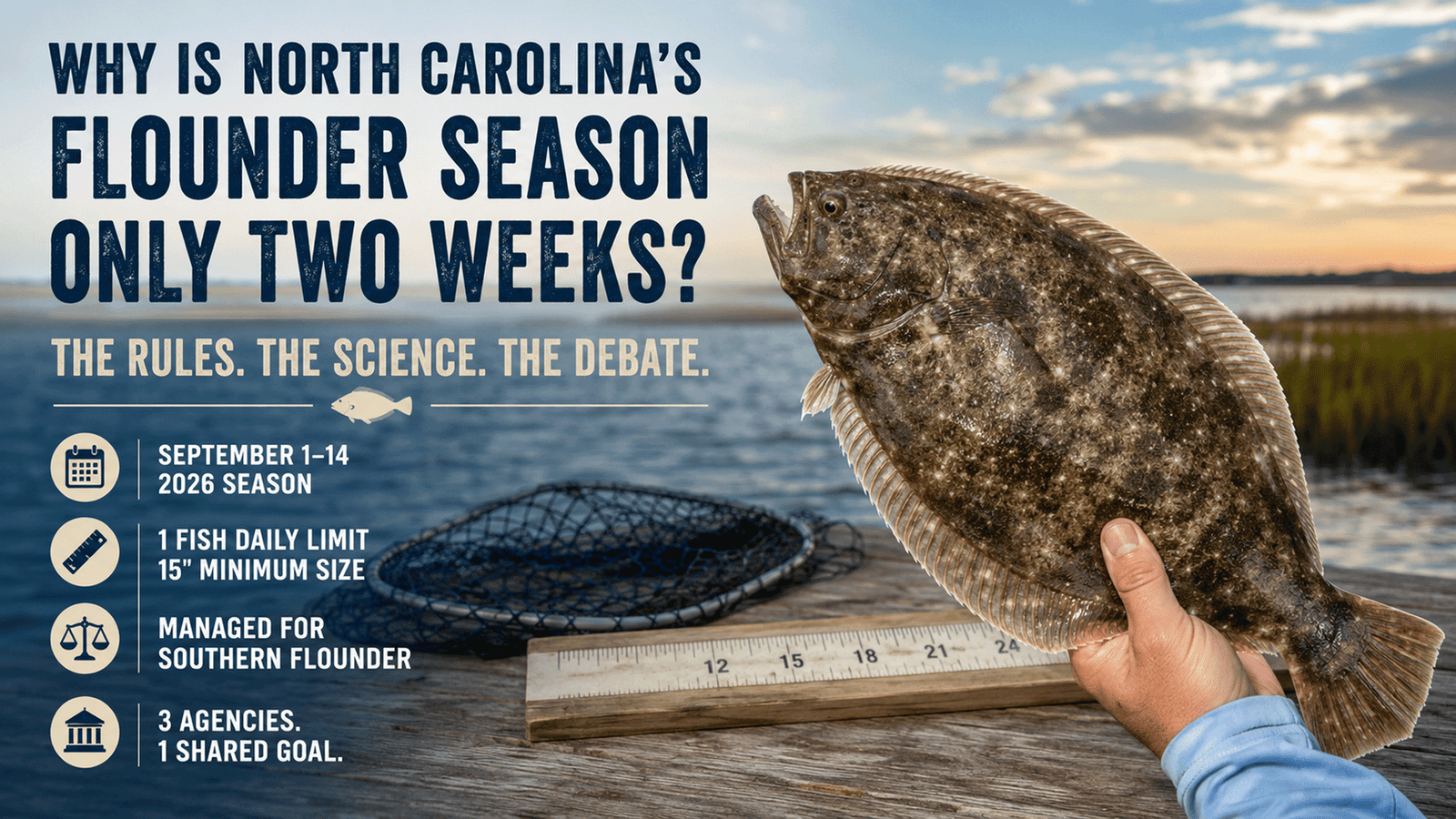
For 2026, North Carolina’s primary recreational flounder harvest season runs from September 1 through September 14. The daily limit is one fish per person, and harvested flounder must measure at least 15 inches in total length. The rules are designed primarily around the management and recovery of Southern Flounder, a species that has been at the center of North Carolina fisheries management discussions for years.
But simply repeating the regulation does not answer the questions many anglers are asking: Why only two weeks? Who actually makes these decisions? Why do the Division of Marine Fisheries and Wildlife Resources Commission both appear to regulate flounder? What about commercial harvest? And if anglers are regularly catching flounder, how can the stock still be considered overfished?
The answers are more complicated than either “the government is taking away fishing” or “the science says the season must be closed.” There are legitimate concerns on multiple sides of the issue.
North Carolina Flounder Regulations for Fall 2026
For anglers planning to harvest flounder during the fall season, the basic rules are straightforward.
- Season: September 1 through September 14, 2026
- Daily recreational limit: One flounder per person per day
- Minimum size: 15 inches total length
- Coastal and Joint Fishing Waters: Recreational hook-and-line and gig fisheries may participate under applicable Marine Fisheries regulations
- Inland Fishing Waters: Hook-and-line fishing only under Wildlife Resources Commission regulations
Anglers should always verify the regulations before fishing because proclamations and rules can change. North Carolina also requires recreational harvest reporting for flounder and several other managed species, adding another source of information fisheries managers can use to better understand recreational harvest.
The Fish at the Center of the Debate: Southern Flounder
North Carolina waters contain more than one species of flounder, but Southern Flounder are the primary species driving the state’s restrictive management measures.
Southern Flounder spend much of their lives in sounds, estuaries, creeks, and other coastal waters familiar to inshore anglers. As they mature, many migrate toward ocean waters to spawn.
State fisheries assessments have concluded that the Southern Flounder stock has been overfished and historically experienced overfishing. Those two terms sound similar but describe different problems.
Overfished generally means the population has fallen below the level managers consider healthy or sustainable. Overfishing means fish are being removed from the population faster than the management target allows.
Once a stock reaches that condition, fisheries managers are required to develop measures intended to rebuild it. In the case of Southern Flounder, those measures have included quotas, shortened seasons, recreational bag limits, commercial restrictions, accountability measures, and changes to how harvest is allocated between recreational and commercial fishermen.
Why Can Anglers Catch Plenty of Flounder if the Stock Is Overfished?
This is one of the most reasonable questions recreational anglers raise.
An angler may fish the ICW, a marsh creek, or an inlet and catch several flounder during a trip. From that person’s experience, the population may appear healthy.
But a stock assessment does not measure whether fish can be caught in one creek, one inlet, or even one region. Fisheries scientists attempt to evaluate the population across a much larger geographic area and over many years.
Fish can also concentrate around particularly productive habitat. A creek mouth holding large numbers of finger mullet may produce several flounder even if the broader population remains below historical or management targets.
That does not mean anglers’ observations are meaningless. Quite the opposite: fishermen spend enormous amounts of time on the water and often recognize changes in fish behavior, abundance, and distribution long before those changes become obvious in broad datasets.
The tension comes when personal observations and population-level assessments appear to tell different stories.
Who Actually Regulates Flounder in North Carolina?
Part of the confusion comes from the fact that North Carolina has more than one government body involved in fisheries management.
N.C. Division of Marine Fisheries
The North Carolina Division of Marine Fisheries, commonly abbreviated DMF or NCDMF, is part of the North Carolina Department of Environmental Quality.
The Division conducts fisheries research, collects harvest information, samples commercial and recreational catches, monitors fish populations, develops management recommendations, issues proclamations, and administers many of the regulations affecting coastal fisheries.
The Division provides the scientific and technical work used in developing Fishery Management Plans.
N.C. Marine Fisheries Commission
The Marine Fisheries Commission is separate from the Division of Marine Fisheries, although the two work closely together.
The Commission is the policy-making body responsible for adopting many fisheries management rules and Fishery Management Plans. Commissioners consider scientific information provided by the Division, recommendations from advisory committees, public comments, economic effects, statutory requirements, and competing interests within the fishery.
That distinction matters. The Division does not simply make every fisheries policy decision by itself.
N.C. Wildlife Resources Commission
The North Carolina Wildlife Resources Commission is another agency entirely. It manages wildlife and inland fisheries throughout the state.
The Wildlife Resources Commission has jurisdiction over Inland Fishing Waters and shares responsibility in designated Joint Fishing Waters. Because flounder can move through waters governed by different agencies, anglers historically faced the possibility of different regulations depending on exactly where they were fishing.
That is why the Wildlife Resources Commission and Marine Fisheries authorities increasingly coordinate their flounder regulations. For 2026, the agencies aligned the September 1–14 season across their respective jurisdictions, although allowed gear differs in some waters.
Are Marine Fisheries and Wildlife Resources Competing Agencies?
They are not intended to be competitors, but anglers can understand why they sometimes appear that way.
The agencies developed under different laws, manage different waters, have different commissions, and historically have approached some fisheries issues differently. Their jurisdictions can also meet in places where an angler may move from one classification of water to another during a single fishing trip.
From a government’s perspective, those are jurisdictional responsibilities.
From an angler’s perspective, it can feel unnecessarily complicated.
The recent effort to align flounder seasons is an acknowledgment of that problem. Having the same basic harvest dates and limits across Coastal, Joint, and Inland waters makes compliance considerably easier for recreational fishermen.
Why Is the Recreational Season So Short?
The short answer is that fisheries managers are trying to provide some recreational harvest opportunity while keeping total removals within the rebuilding limits established for Southern Flounder.
A longer season does not simply mean more days available to individual fishermen. It also increases the total number of fish likely to be harvested by the entire recreational sector.
Managers therefore use season length along with bag limits, size limits, harvest estimates, and other controls to keep recreational removals within the assigned quota.
The one-fish daily limit reduces harvest per angler. The two-week season limits the number of days during which recreational harvest can occur.
Whether that balance provides enough recreational access is where much of the disagreement begins.
The Commercial Versus Recreational Debate
No discussion of North Carolina flounder management is complete without acknowledging one of the most persistent concerns raised by recreational fishermen: the division of harvest between the commercial and recreational sectors.
Some recreational anglers argue that it is difficult to accept a two-week season and one-fish limit while commercial fishermen continue to have access to the same resource under a separate quota and management system.
Commercial fishermen have concerns of their own. Commercial fishing is not simply recreation with larger limits. For many participants, it is a livelihood involving boats, licenses, gear, fuel, employees, seafood dealers, restaurants, and coastal businesses that depend upon access to the resource.
Reducing commercial allocation can therefore have direct economic consequences for fishing families and communities.
North Carolina has attempted to address part of the conflict through changes in allocation. Southern Flounder management now uses a 50/50 allocation between the commercial and recreational sectors, a change that was accelerated through Amendment 4 of the Southern Flounder Fishery Management Plan.
That does not mean the debate is resolved.
Many recreational fishermen continue to question whether allocation, gear impacts, harvest estimates, and accountability are equitable. Commercial fishermen may question whether further reductions can occur without threatening the viability of their businesses.
Both groups can make legitimate arguments while still wanting the same thing: enough flounder in the water to support fishing in the future.
Why Do Recreational Anglers Question the Data?
Recreational harvest is inherently difficult to measure.
A commercial fishery has dealers, trip tickets, licenses, and documented landings that provide managers with relatively direct information about how many pounds of fish enter the marketplace.
Recreational fishing involves thousands of individual anglers launching from ramps, fishing from private docks, surf fishing, kayaking, fishing from piers, taking charter trips, and accessing waterways from countless locations.
Estimating that harvest requires surveys, sampling, statistical models, and assumptions.
That has led some recreational anglers to question whether harvest estimates accurately represent what fishermen are actually catching and keeping.
Those concerns should not automatically be dismissed as opposition to conservation. Accuracy matters because recreational harvest estimates directly influence season length and access.
North Carolina’s newer mandatory harvest reporting requirements for species including flounder are partly intended to improve the information available to fisheries managers.
The Conservation Viewpoint
There is also a substantial group of anglers who support restrictive measures even when those restrictions limit their own fishing.
Their argument is straightforward: if Southern Flounder abundance has declined significantly, allowing heavy harvest simply because the species remains popular could delay recovery and ultimately lead to even fewer fishing opportunities.
From that perspective, a short season today may help create a healthier fishery tomorrow.
Many anglers who support conservation measures would still like better data, clearer explanations, equitable treatment between sectors, and greater recreational access as the stock improves.
Supporting conservation and questioning fisheries policy are not mutually exclusive positions.
What About the Marine Fisheries Commission?
The Marine Fisheries Commission itself has recognized concerns about recreational access.
Recent amendments to the Southern Flounder Fishery Management Plan have specifically examined allocation and recreational opportunity. Amendment 4 moved the fishery to a 50/50 commercial and recreational allocation earlier than previously scheduled.
Work on Amendment 5 is considering broader and longer-term management questions, including issues raised by commissioners, advisory committees, commercial fishermen, recreational anglers, and members of the public.
That is important because the current regulations should not necessarily be viewed as the permanent final form of North Carolina flounder management.
The management system is continuing to evolve.
Why Not Just Make Flounder Catch-and-Release All Year?
Outside the harvest season, anglers can still encounter flounder while fishing for other species. Catch-and-release fishing therefore remains part of the fishery.
Some fishermen would prefer a longer harvest season with lower limits. Others favor short harvest seasons combined with year-round catch-and-release opportunity. Still others believe recreational anglers should receive a significantly larger share of allowable harvest.
Every approach creates tradeoffs.
A longer season can increase total harvest. Larger minimum sizes can protect younger fish but may increase pressure on mature females. Extremely short seasons concentrate fishing effort into a small window. Catch-and-release fisheries can still experience some release mortality.
There is no management option that provides unlimited access without biological consequences.
What the Debate Often Misses
The loudest arguments can make it appear that North Carolina anglers fall into two camps: fishermen who care about conservation and fishermen who care about access.
That is rarely an accurate description.
Most recreational anglers want healthy fish populations. They also want reasonable opportunities to harvest fish for dinner.
Most commercial fishermen depend upon healthy fish populations because an exhausted resource threatens their livelihood.
Fisheries scientists generally want management decisions supported by the best information available.
Commissioners must balance biological, economic, social, and legal considerations while making decisions that will inevitably disappoint someone.
The disagreement is usually not about whether Southern Flounder should exist for future generations.
The disagreement is about how quickly the stock needs to rebuild, how confident everyone should be in the available data, how the allowable harvest should be divided, which fishing methods should bear reductions, and how much access today’s fishermen should sacrifice for tomorrow’s fishery.
What This Means for Topsail Island Anglers
For anglers around Topsail Island, the September season arrives during an excellent time to encounter flounder.
By late summer, finger mullet and other baitfish are moving heavily through the area’s creeks, marsh drains, ICW shoreline, inlets, docks, bridges, and beachfront waters. Flounder frequently position themselves along those travel corridors waiting for bait to move past.
Productive locations can include creek mouths, dock edges, marsh drains, oyster transitions, channel drop-offs, bridge structure, inlet areas, and deeper holes adjacent to shallow flats.
Live finger mullet and mud minnows are traditional choices. Paddle tails, bucktails, scented soft plastics, and other bottom-oriented artificial presentations can also produce excellent fishing.
Before harvesting a fish, measure carefully and make sure you understand the regulations for the specific water in which you are fishing.
Planning for September 1
Anglers intending to participate in the September harvest season should prepare before opening morning rather than trying to understand the rules after a fish is already on the deck.
Check the current proclamation and regulations shortly before the season begins. Carry an accurate measuring device. Understand the one-fish daily limit. Know how and when harvested flounder must be reported. And confirm whether the water you are fishing is classified as Coastal, Joint, or Inland Fishing Waters.
Most importantly, remember that a legal harvest opportunity does not require an angler to keep a fish. Some fishermen will keep their one legal flounder for dinner. Others will choose to release every fish they catch.
Both decisions can be part of responsible recreational fishing.
A Debate Worth Having Without Choosing Sides
North Carolina’s flounder restrictions are frustrating for many fishermen, and that frustration should not simply be dismissed. Recreational anglers contribute substantially to coastal communities through boats, fuel, tackle, tourism, charters, lodging, restaurants, and countless other purchases. Access to healthy fisheries matters economically as well as culturally.
At the same time, fisheries managers cannot ignore evidence indicating that Southern Flounder abundance requires rebuilding. Commercial fishermen also have livelihoods tied to the resource and legitimate concerns about reductions that affect their ability to make a living.
The challenge is finding a management system that produces healthy flounder populations while providing meaningful and equitable access to the people who depend upon them recreationally and commercially.
Reasonable people can disagree about whether North Carolina has found that balance.
What should not be controversial is the ultimate objective: a Southern Flounder population healthy enough that future anglers can argue about where to catch them rather than whether there are enough fish left to catch.
Learn More Before You Fish
For seasonal fishing information, species guides, captain reports, and current fishing resources around Topsail Island, visit the Topsail Island Fishing Intel Center.
Anglers looking for techniques, rigs, bait presentations, and local fishing strategies can browse the Topsail.Fish How-To Articles.
If you would rather fish with someone who understands Topsail’s creeks, marshes, inlets, and changing seasonal patterns, browse our local captain directory and Book a Charter with a Topsail-area fishing guide.
Stay Informed and Get Involved
North Carolina’s fisheries are constantly evolving as new research, public input, and management decisions shape future regulations. Whether you support the current flounder rules or believe changes are needed, staying informed is the best way to make your voice heard. The North Carolina Division of Marine Fisheries (NCDMF) provides fisheries research, stock assessments, proclamations, and recreational fishing information. The North Carolina Marine Fisheries Commission (MFC) establishes many of the policies and regulations governing coastal fisheries and regularly accepts public comment. The North Carolina Wildlife Resources Commission (NCWRC) oversees Inland and Joint Fishing Waters and publishes regulations affecting anglers across the state. We encourage every fisherman—whether recreational or commercial—to follow these agencies, review proposed rule changes, and participate in the public process. Well-informed anglers help build better fisheries for everyone.
Continue Exploring Topsail.Fish
Whether you’re planning your first trip to Topsail Island or you’ve been fishing these waters for years, Topsail.Fish brings together local fishing knowledge, current conditions, trusted charter captains, seasonal guides, and practical resources to help you make the most of your time on the water.
Follow Our Progress
Each month we publish a Topsail.Fish Monthly Report that shares how the website is growing, what anglers are searching for, how visitors are using the site, how they are connecting with local captains, and how participating businesses are gaining visibility. It’s our way of documenting the steady growth of the Greater Topsail Island fishing community.
🎣 Planning a trip to the NC coast? Before you book a boat down south, check out why Topsail vs. Wilmington fishing offers a better backwater experience. 🎣

Are you a Topsail Area Captain?
Grow your charter business with an SEO-optimized listing in our directory. For just $12/month, we help you reach more anglers and secure the consistent bookings you need to thrive.