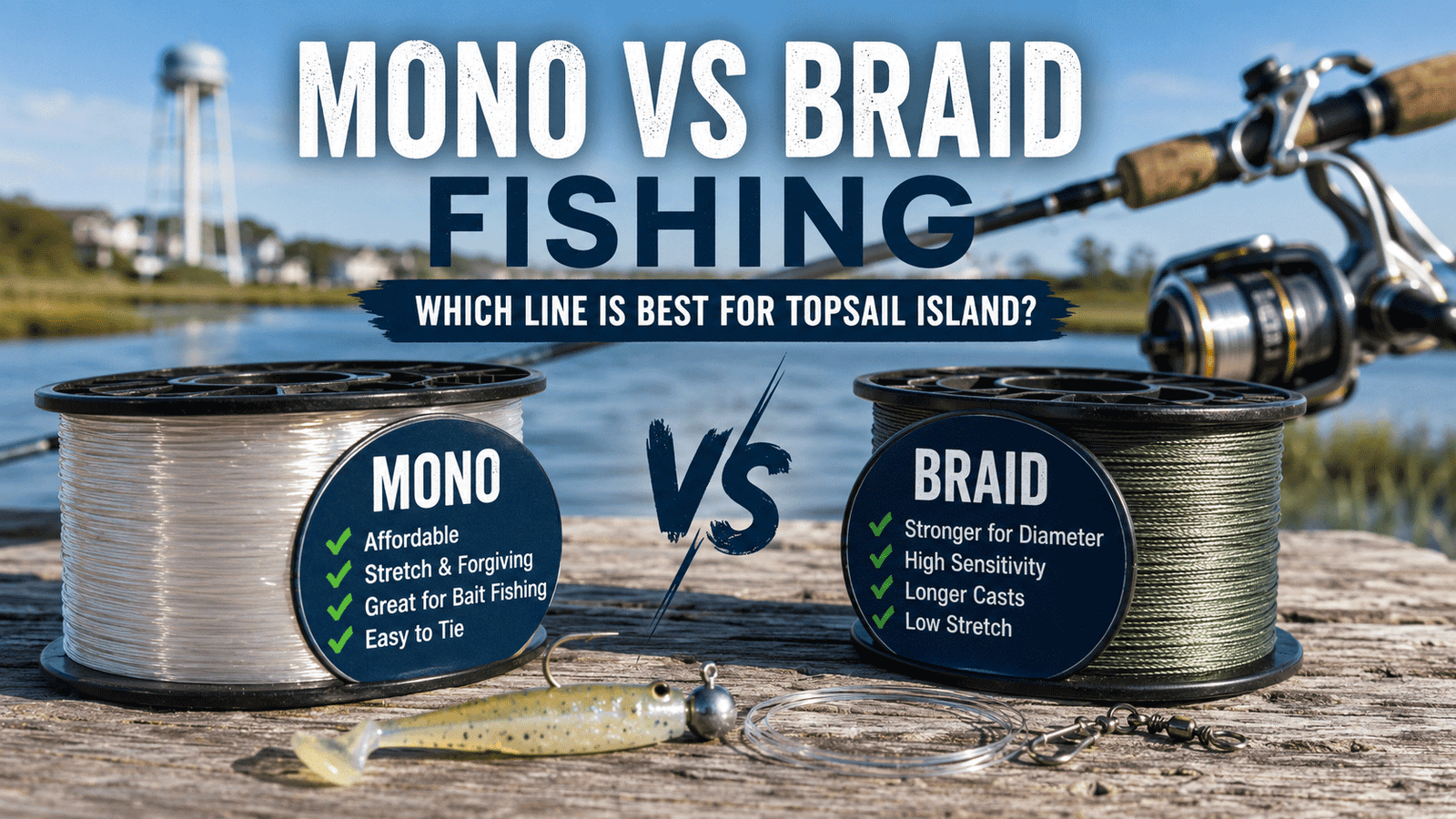
Mono vs Braid Fishing: Which Line Is Best for Topsail Island?
Choosing between monofilament and braided fishing line can seem like a minor tackle decision, but your fishing line affects nearly everything that happens between the cast and the catch. Casting distance, lure action, sensitivity, hooksets, abrasion resistance, and even how easily you land a fish can all depend on the line spooled onto your reel.
The mono vs braid fishing debate does not have one universal winner. Both lines have strengths, weaknesses, and situations where they perform exceptionally well. For anglers fishing around Topsail Island, the best choice often depends on whether you are casting from the beach, working an inshore creek, fishing around docks, dropping bait from a pier, or trolling outside the inlet.
Understanding how each line behaves will help you select the right setup for red drum, speckled trout, flounder, Spanish mackerel, black drum, sheepshead, and many other fish found along the North Carolina coast.
What Is Monofilament Fishing Line?
Monofilament fishing line, commonly called mono, is made from a single continuous strand of nylon or a similar material. It has been used by generations of anglers because it is affordable, widely available, easy to handle, and suitable for many types of fishing.
One of mono’s defining characteristics is its stretch. When pressure is applied, the line expands slightly rather than remaining completely rigid. That stretch acts as a shock absorber when a fish strikes, makes a sudden run, shakes its head, or surges beside the boat.
Mono is also relatively easy to tie. Common fishing knots cinch down securely, making it a practical option for beginners, occasional anglers, and anyone who prefers a simple rig without a separate leader connection.
Advantages of Monofilament
- Generally less expensive than braided line
- Easy to tie and manage
- Stretch helps absorb sudden strikes and runs
- Available in clear and low-visibility colors
- Works well for many bait-fishing and trolling applications
- Can be tied directly to hooks, swivels, and lures
- More forgiving when fighting fish
Disadvantages of Monofilament
- Thicker than braid at the same pound-test rating
- Has less sensitivity because of its stretch
- Can develop coils or spool memory
- Usually does not cast as far as thin braided line
- Can degrade after extended exposure to sunlight and saltwater
- May need to be replaced more frequently
What Is Braided Fishing Line?
Braided fishing line is made from multiple synthetic fibers woven together into a very thin, strong line. Modern braid offers impressive strength compared with its diameter. A reel can therefore hold more braided line than monofilament of a similar breaking strength.
Braid has very little stretch. That characteristic gives anglers a more direct connection to the lure, bait, and fish. Small taps, changes in bottom composition, grass, shells, and subtle strikes are often easier to detect with braid.
Its thin diameter and flexible construction also improve casting distance. This can be especially useful when fishing from the surf, casting across shallow flats, or trying to reach feeding fish without moving the boat closer.
Advantages of Braided Line
- Very strong for its diameter
- Excellent sensitivity
- Little to no spool memory
- Long casting distance
- Allows more line capacity on a reel
- Useful for fishing in deeper water or strong current
- Provides solid hooksets at a distance
- Generally lasts longer on the reel than mono
Disadvantages of Braided Line
- More expensive initially
- Highly visible in clear water
- Requires knots designed to resist slipping
- Can cut fingers when pulled under tension
- May dig into itself on the reel after a hard pull
- Low stretch can cause pulled hooks if the drag is too tight
- Can be difficult to untangle after a severe wind knot
Mono vs Braid Fishing for Inshore Species
Inshore fishing around Topsail Island includes marsh creeks, oyster beds, docks, bridges, flats, sounds, and stretches of the Intracoastal Waterway. These environments can hold red drum, speckled trout, flounder, black drum, sheepshead, and other popular species.
For many inshore applications, braided main line connected to a monofilament or fluorocarbon leader offers the most versatile setup. Braid provides casting distance and sensitivity, while the leader reduces visibility and offers additional protection near shells, pilings, and a fish’s mouth.
A typical light inshore spinning setup may use 10- to 20-pound braid with an appropriately sized leader. The exact strength should be adjusted for the reel, target species, lure weight, water conditions, and structure being fished.
Mono remains a good option when fishing live or cut bait, particularly when a little stretch helps prevent a fish from immediately feeling heavy resistance. Anglers using circle hooks may also appreciate mono’s forgiving nature because the line can tighten gradually as the hook slides into the corner of the fish’s mouth.
Braid vs Mono for Red Drum
Braided line is an excellent choice when casting artificial lures for red drum. Its sensitivity helps anglers feel soft plastics bouncing across sand, mud, shell, or submerged grass. The lack of stretch also helps drive the hook home when a red strikes at the end of a long cast.
When fishing near oyster beds, docks, or other abrasive structure, use a leader strong enough to withstand contact. Braid itself is strong, but its thin fibers may be vulnerable when repeatedly rubbed across sharp shells or barnacle-covered pilings.
Mono can work very well for red drum when fishing cut mullet, shrimp, or live bait. The stretch provides a cushion during powerful runs and may help keep steady pressure on a fish without tearing the hook loose.
Braid vs Mono for Speckled Trout
Speckled trout often strike lightly, particularly during cold weather or periods when they are feeding cautiously. Braid makes these subtle bites easier to detect and helps anglers feel the action of soft-plastic jigs, suspending lures, and small topwater plugs.
However, trout have relatively delicate mouths. An overly aggressive hookset with braided line can enlarge the hook hole or pull the lure away from the fish. A properly adjusted drag, a flexible rod tip, and a short leader can provide some of the forgiveness that braid lacks.
Mono may be preferred by anglers fishing treble-hook lures because its stretch can help prevent small hooks from tearing free during headshakes.
Braid vs Mono for Flounder
Sensitivity is especially important when targeting flounder. A flounder may grab a bait and remain nearly motionless before attempting to swallow it. Braid helps the angler detect unusual weight, a faint tap, or the sensation that the rig has stopped moving.
When jigging soft plastics or slowly working a bait along the bottom, braided main line usually provides the best contact. A leader should still be used to reduce visibility and protect the final section of line from bottom structure.
Mono remains suitable for traditional live-bait rigs, especially when the angler wants a more forgiving presentation and is willing to trade some sensitivity for simplicity.
Which Line Is Better for Surf Fishing?
The best line for surf fishing depends on the target species and the type of rig being used.
Braid’s thin diameter can help anglers cast farther and hold more line on the reel. It also creates less resistance in strong current than thicker monofilament of comparable strength. These qualities are useful when casting lures for Spanish mackerel, bluefish, or other actively feeding fish.
However, braid has little stretch, and surf conditions can place sudden pressure on the line. Waves, heavy sinkers, strong fish, and long casts all create opportunities for shock. A monofilament shock leader may be necessary when casting heavier sinkers with braid.
Mono is still widely used for soaking bait in the surf. Its stretch absorbs wave action and sudden runs, and its lower cost makes filling large-capacity surf reels more affordable. Mono is also easier for many anglers to handle when tying bottom rigs or replacing damaged line on the beach.
Which Line Is Better for Pier Fishing?
Pier anglers encounter pilings, barnacles, railings, and other abrasive surfaces. Either line can work, but each requires careful use.
Braid offers strength and sensitivity, making it useful for jigging, casting lures, or detecting bites beneath the pier. Its thinner diameter also allows anglers to use stronger line without sacrificing as much reel capacity.
The concern is abrasion. When braid touches a barnacle-covered piling under tension, it can be damaged quickly. A durable mono or fluorocarbon leader provides an important buffer between the braid and the structure.
Mono is inexpensive, easy to replace, and often more forgiving when lifting or guiding fish around the pier. For anglers fishing simple bottom rigs, float rigs, or live bait, straight monofilament remains a dependable choice.
Should You Use a Leader with Braided Line?
In most Topsail-area saltwater situations, using a leader with braid is recommended. The leader serves several purposes:
- Reduces the visibility of the terminal connection
- Provides abrasion resistance near shells, rocks, pilings, and fish
- Adds a small amount of shock absorption
- Makes it easier to replace the damaged end of the line
- Prevents the braid from contacting the lure or hook directly
Monofilament leaders are affordable, flexible, and effective for many presentations. Fluorocarbon leaders are often selected when water clarity, abrasion resistance, or a less visible presentation is especially important.
Popular braid-to-leader connections include the double uni knot, Alberto knot, and FG knot. The best choice is the knot you can tie correctly and consistently. A technically advanced knot offers little benefit if it is poorly tied.
Does Braid Need Monofilament Backing?
Braided line can slip around a smooth reel spool if it is attached without sufficient grip. A short layer of monofilament backing helps anchor the braid and prevents the entire spool of line from rotating under pressure.
Backing can also reduce the amount of expensive braid needed to fill the reel. The reel should still contain enough braid for the intended fishing situation, but there is usually no reason to bury hundreds of unused yards beneath the working portion of the line.
Some modern reels have braid-ready spools with textured surfaces or rubber inserts. Follow the reel manufacturer’s instructions before deciding whether backing is required.
Is Mono or Braid Better for Beginners?
Monofilament is often the easiest line for a new angler. It is affordable, knots are relatively simple to tie, and the stretch makes it forgiving during hooksets and fish fights. A beginner can spool a reel with mono, tie directly to a hook or lure, and begin fishing without learning an additional leader knot.
Braid becomes valuable once an angler wants greater casting distance, sensitivity, strength, or line capacity. It is not necessarily difficult to use, but it requires more attention to drag settings, knots, spool tension, and leader connections.
A beginner who fishes frequently may quickly benefit from a braided main line with a mono leader. Someone who fishes only occasionally may find that straight monofilament provides everything needed.
How Long Does Fishing Line Last?
Monofilament should be inspected regularly for coils, cloudiness, rough spots, flattening, or reduced knot strength. Sunlight, heat, saltwater, repeated stretching, and abrasion gradually weaken it. Anglers who fish often may replace mono several times during a season, while occasional anglers should at least inspect and replace it when deterioration becomes apparent.
Braid generally lasts longer because it does not develop the same type of spool memory and is less affected by sunlight. However, it can still become faded, frayed, flattened, or damaged. The working end receives the most abuse and should be checked after fishing around docks, oysters, rocks, bridges, or other structure.
Saltwater anglers should rinse reels gently with fresh water after use and allow them to dry. Avoid blasting the reel with high-pressure water, which can force salt and debris deeper into its components.
Mono vs Braid Fishing: The Final Decision
For most anglers using spinning tackle in Topsail Island’s inshore waters, braided main line with a monofilament or fluorocarbon leader provides the best overall combination of casting distance, sensitivity, strength, and versatility.
That does not make monofilament obsolete. Mono remains an excellent choice for beginners, bait fishing, trolling, surf rigs, treble-hook lures, and any situation where stretch and forgiveness are beneficial. It is also inexpensive and easy to work with.
Choose braid when sensitivity, casting distance, strength, or line capacity matters most. Choose mono when simplicity, shock absorption, affordability, and easy handling are more important.
The real answer to the mono vs braid fishing question is not that one line is always better. The better line is the one that matches your reel, technique, target species, and the structure you expect to encounter. Many experienced Topsail-area anglers keep several rods ready with different line combinations so they can adapt as conditions change.
Before your next trip, inspect your line, test your knots, adjust your drag, and make sure your setup matches the fish you plan to pursue. A few minutes spent preparing your tackle can prevent a worn line or weak connection from costing you the best fish of the day.
Keep Building Your Topsail Fishing Skills
Want to put this technique to work on your next trip? Use these Topsail.Fish resources to check current fishing activity, match your tactics to the season, review local conditions, and find more step-by-step fishing guides.
🎣 Planning a fishing trip to coastal North Carolina? Before choosing a charter destination, discover why many anglers prefer Topsail Island’s less crowded waters, productive back bays, and outstanding inshore and surf fishing opportunities.
🎣 Planning a trip to the NC coast? Before you book a boat down south, check out why Topsail vs. Wilmington fishing offers a better backwater experience. 🎣

Are you a Topsail Area Captain?
Grow your charter business with an SEO-optimized listing in our directory. For just $12/month, we help you reach more anglers and secure the consistent bookings you need to thrive.