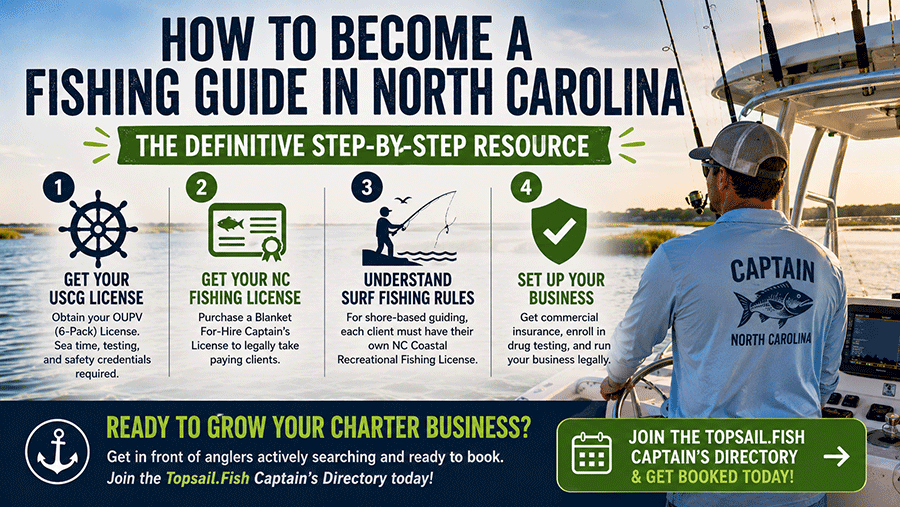
How to Become a Fishing Guide in North Carolina: The Definitive Step-by-Step Resource
So you want to know how to become a fishing guide in North Carolina? Turning your passion for the water into a career as a professional captain is incredibly rewarding, but navigating the legal requirements can feel like trying to untangle a bird’s nest in the wind.
Operating a legal charter business in NC requires passing a strict set of federal guidelines alongside state-level marine fisheries licensing. If you skip a step, you risk massive fines, boat seizure, or losing your privileges entirely.
This guide breaks down exactly how to get a fishing guide license, get your credentials in order, and launch a legitimate charter business on the NC coast.
1. The Foundation: Federal USCG Captain’s License
Before you can apply for any state-level fishing guide permits, federal law dictates that anyone taking passengers for hire on navigable waters must hold a United States Coast Guard (USCG) Merchant Mariner Credential.
For the vast majority of local inshore and nearshore guides, you will need the OUPV (Operator of Uninspected Passenger Vessels) License, commonly referred to as the 6-Pack License. This allows you to carry up to 6 paying passengers on an uninspected vessel.
Key USCG Requirements:
-
Sea Time: You must document at least 360 days of experience on a vessel (90 of those days must be within the last 3 years).
-
Testing: You must pass a comprehensive physical exam, a drug screening, and a rigorous USCG exam covering navigation rules, plotting, deck safety, and seamanship.
-
Safety Credentials: You must hold valid CPR and First Aid certifications.
-
Twic Card: You must obtain a Transportation Worker Identification Credential (TWIC) from the TSA, which includes a federal background check.
⚓ Official Resource: You can check the current application requirements and processing queues directly via the USCG National Maritime Center.
2. North Carolina Fishing License Requirements
Once you have your Coast Guard credentials, you must legally register with the state. The North Carolina Division of Marine Fisheries (NCDMF) handles all commercial and charter licensing.
To take paying clients into NC coastal waters, you cannot simply use a standard recreational license. You must possess a specialized commercial permit.
The Standard Commercial License vs. Blanket For-Hire License
To legally operate, you must purchase a Blanket For-Hire Captain’s License (or a For-Hire Vessel License).
-
The Big Advantage: A “blanket” license covers everyone on your boat. Your paying clients do not need to buy an individual North Carolina fishing license to fish with you; your captain’s permit legally covers them for the day.
-
Cost: As of 2026, the annual fee for a resident blanket for-hire license is roughly $250 (non-residents pay more).
🐟 Official Resource: Applications and exact fee structures must be submitted through the North Carolina Division of Marine Fisheries (NCDMF) License Office.
3. North Carolina Surf Fishing License Requirements
Because topsail.fish receives significant traffic regarding beach fishing, it is vital to clear up a major area of confusion for new guides: guiding clients from the sand.
If you are guiding clients for surf fishing, shore fishing, or kayak fishing where you are not operating a motorized vessel covered by a USCG 6-pack, the legalities shift slightly:
-
CRFL Requirements: Unlike a charter boat, there is no blanket license for a shore-based guide.
-
Every single client you take onto the beach must purchase their own individual North Carolina Coastal Recreational Fishing License (CRFL).
-
The Guide’s Duty: As a commercial shore guide, you must still register your business entity with the state and carry proper commercial liability insurance, but your clients must handle their own personal recreational permits via the NC Wildlife Resources Commission.
4. Setting Up Your Business and Insurance
Holding the licenses isn’t enough; you are running a business. To protect your assets and stay compliant, ensure you complete these final structural steps:
-
Commercial Liability Insurance: Standard boat insurance will not cover you if a paying passenger is injured. You need specialized charter boat insurance (typically carrying a $1,000,000 liability limit).
-
Enroll in a Drug Testing Consortium: The USCG requires all active captain’s license holders to be enrolled in a random drug testing program. You must maintain active proof of enrollment.
Continue Exploring Captain Resources
Whether you’re an experienced charter captain or just beginning your guiding career, the For Captains section of Topsail.Fish is designed to help you build a stronger business. Explore professional resources, marketing updates, directory tools, fishing reports, and educational content created specifically for fishing guides throughout the Greater Topsail Island area.
🎣 Planning a trip to the NC coast? Before you book a boat down south, check out why Topsail vs. Wilmington fishing offers a better backwater experience. 🎣

Are you a Topsail Area Captain?
Grow your charter business with an SEO-optimized listing in our directory. For just $12/month, we help you reach more anglers and secure the consistent bookings you need to thrive.